Which material should you consider?
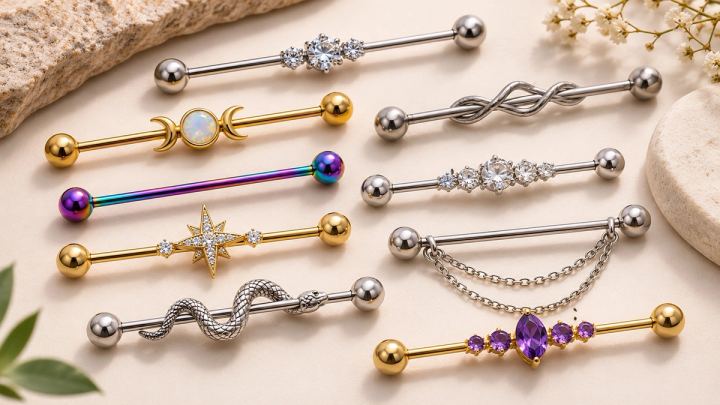
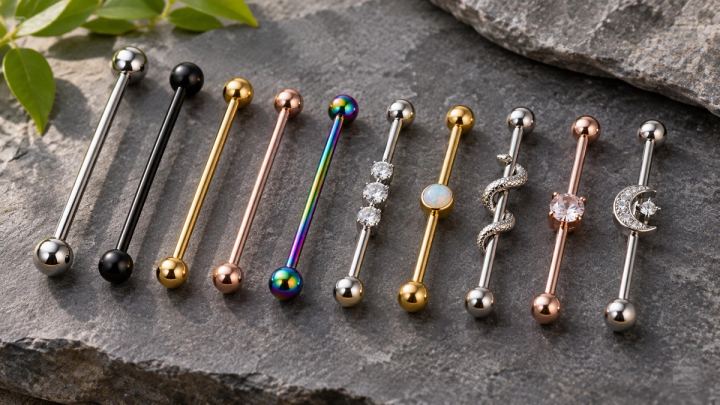
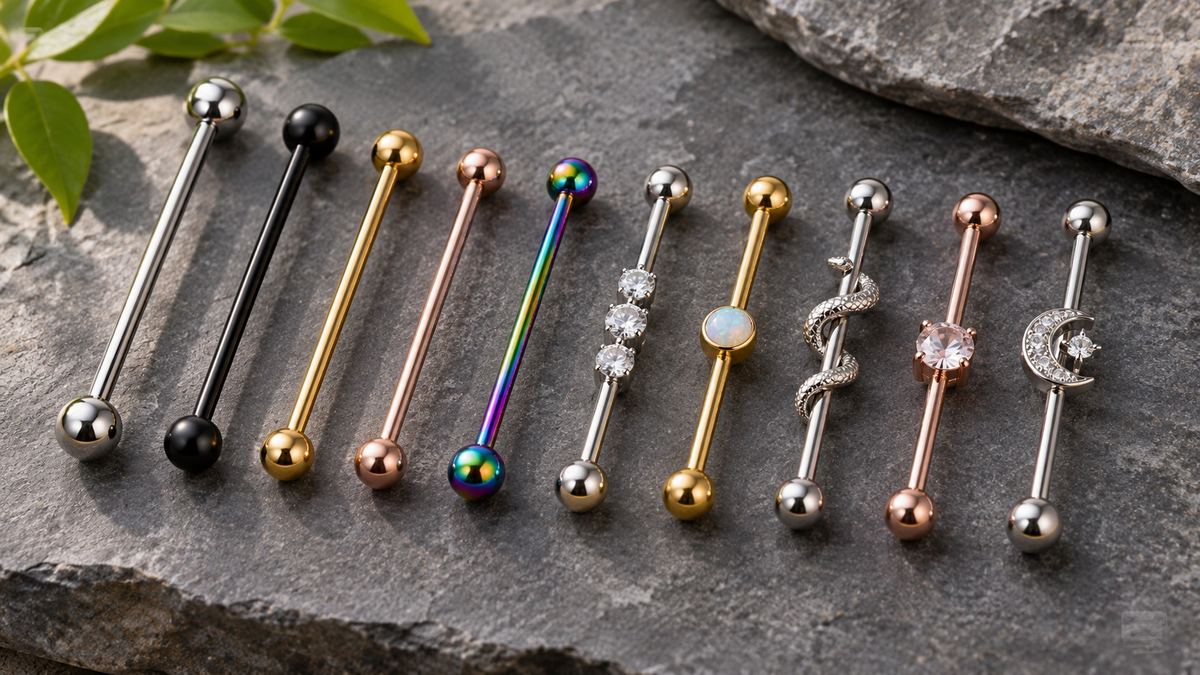
Choose industrial jewellery by documented alloy, surface quality and compatibility with your placement. Titanium, suitable steel and appropriate gold alloys are different material choices; colour and broad marketing terms do not identify their composition.
Titanium and the importance of documentation
Titanium is a popular choice for people seeking light jewellery and for those discussing metal sensitivity with a piercer. But a product name that says titanium is not equivalent to an independently documented implant-compatible grade. Examples of standards relevant to body jewellery include ASTM F136 for a particular titanium alloy and ASTM F67 for commercially pure titanium. A reputable supplier should be able to identify what it actually uses. The same attention should extend to the terminal components if they contact the piercing. An anodised finish may give titanium a gold or rainbow appearance without changing the bulk metal into gold. Our titanium industrial jewellery guide examines these distinctions in more detail.
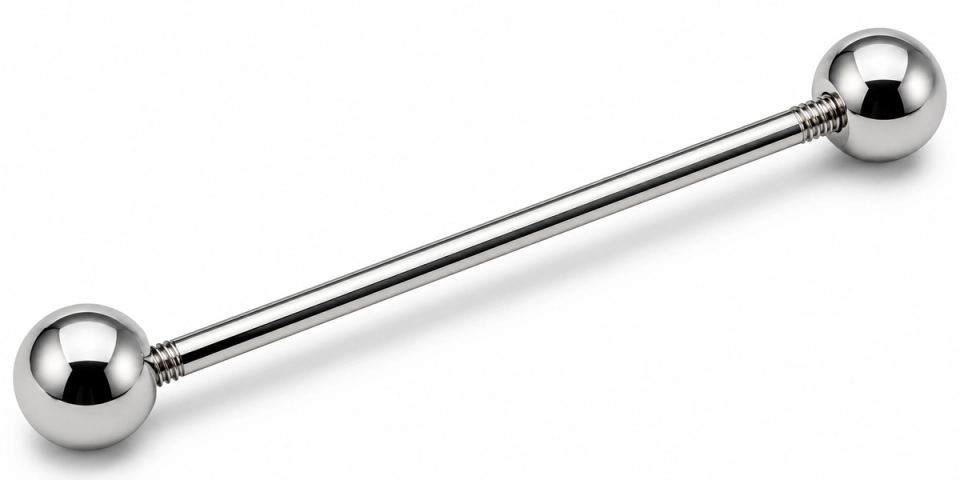
Steel is a family of alloys
Steel has practical advantages in jewellery, including a familiar bright appearance and broad design availability. However, the term surgical steel is not a complete grade specification. Some steel alloys contain nickel, and the suitability of a specific piece depends on documented material and construction. ASTM F138 is one relevant designation for steel used in appropriate body jewellery; merely seeing 316L in a listing does not establish that the specific material meets every requirement for initial piercing jewellery. For an established industrial, ask your piercer whether the exact alloy is a reasonable choice for you. The stainless steel guide covers how to compare the documentation and limitations of catalogue descriptions.
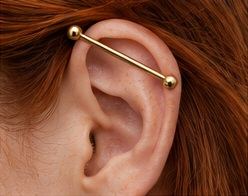
Gold, gold colour and surface layers
Solid gold jewellery is made from an alloy whose gold content is expressed in karats or fineness. A gold-coloured steel piece may instead have a surface coating, and a gold-coloured titanium piece may use anodisation. These are not interchangeable descriptions. Even solid gold is an alloy at common jewellery finenesses, so the other metals matter. The Association of Professional Piercers provides guidance on appropriate gold jewellery for initial placements, including suitable fineness and composition. Ask a supplier to identify the shaft, setting and ends separately. Our gold industrial jewellery guide explains the difference between genuine gold content and finishes, and why price and colour are unreliable shortcuts.
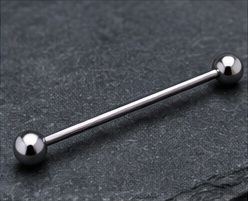
The finish and join are part of the specification
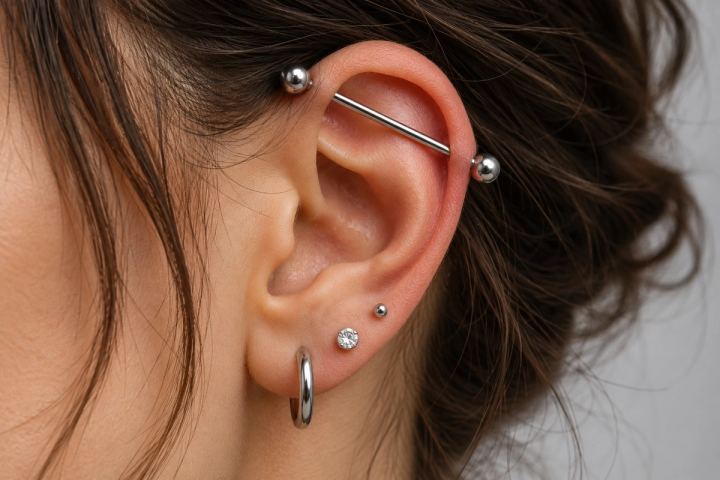
A suitable alloy is only one part of a suitable piece. A long bar has two channels to pass through and two end attachments to secure. Rough surfaces, a poorly seated end or an irregular join may be troublesome irrespective of the name of the metal. The shaft should have a smooth finish where it contacts tissue, and the fastening system should be appropriate to the design. An ornament can have a material different from the shaft; consider whether it rests close to the ear, catches on hair or is difficult to keep clean. Our size guide addresses how construction and end profile interact with the nominal measurements.
When you have reacted to jewellery before
Previous reactions to earrings are useful information to share with your piercer and, where appropriate, a medical professional. Itching and soreness can have more than one cause. Pressure from a badly fitting bar, irritation from movement and a reaction to a material are not the same problem, and changing one material without assessing the fit may not resolve the issue. If there are concerning symptoms, seek appropriate medical advice. The sensitive ears guide explains how to make a more informed purchase without treating hypoallergenic as a universal guarantee. For another example of material choices in cartilage jewellery, see our titanium cartilage earring guide.
What to request from a merchant
Before ordering, ask for a precise material designation, the usable length and gauge, the threading system, and an explanation of any surface treatment. If the product has a central charm, ask whether the charm and shaft have the same composition. When a listing claims a particular ASTM grade, treat that as a merchant claim unless you have supporting evidence. Product names and photographs are helpful for identifying design, but neither proves certification. A suitable piece for a healed piercing may not be an appropriate first piece for a fresh one. The complete industrial jewellery guide puts the material decision in the context of anatomy, fit and timing.
We may earn a commission through affiliate links. These examples are selected from supplied merchant specifications, not independently tested. Confirm current price, availability, material and fit before buying.
OUFER catalogue examples for established piercings

OUFER Blue Butterfly Industrial Barbell
A blue butterfly centrepiece. The merchant claims ASTM F138 stainless steel in the feed and identifies 14G in the destination. Confirm documentation, usable length and the depth of the ornament.
Check price at Oufer
OUFER Moon and Sun Industrial Barbell
The merchant describes a 14G celestial design made with surgical stainless steel. The exact grade and wearable length are not established in the supplied feed.
Check price at Oufer
OUFER Simple Chain Industrial Barbell
A chain-decorated industrial identified as 14G, with 316L stainless steel in the merchant destination. Confirm shaft length, chain dimensions and material documentation.
Check price at Oufer
OUFER Star Industrial Barbell
The merchant identifies a 14G star design and lists 316L stainless steel in its destination. Verify the wearable length and clearance around the star.
Check price at Oufer
WICKED × OUFER Magic Broom Industrial Barbell
The feed describes a 38 mm sculpted broom design and claims ASTM F138 stainless steel. Confirm whether the stated length is wearable length, the gauge and the ornament's clearance.
Check price at OuferFrequently asked questions
Is titanium always nickel-free?
Ask for the actual composition and grade of the piece; the material name alone does not establish every component's composition.
Does gold colour mean solid gold?
No. It can result from plating, coating or anodisation.
Is surgical steel a standard?
It is a broad description, not by itself a specific alloy certification.
Sources and further reading
Industrial Piercing Jewellery Library
Complete guide
Main guides
- Best Industrial Piercing Barbells
- Industrial Piercing Jewellery Sizes and Measurements
- Industrial Piercing Jewellery Styles and Designs
Supporting guides
- Best Industrial Barbells for Everyday Wear
- Industrial Piercing Jewellery for Sensitive Ears
- Industrial Piercing Barbell Length Guide
- Industrial Piercing Gauge Guide: 14G vs 16G
- How Should an Industrial Piercing Barbell Fit?
- Titanium Industrial Piercing Jewellery
- Gold Industrial Piercing Jewellery
- Stainless Steel Industrial Piercing Jewellery
- Industrial Piercing Chain Jewellery
- Minimalist Industrial Piercing Jewellery
- Decorative Industrial Barbells: Gems, Opals and Charms
- Vertical Industrial Piercing Jewellery
- Industrial Piercing Anatomy: Will Your Ear Accommodate a Barbell?
- When Can You Change Industrial Piercing Jewellery?