Which measurements matter?
Industrial barbell sizing requires at least two measurements: shaft thickness (gauge) and wearable shaft length. Your piercer should confirm the dimensions and how the ends and central shaft clear your own ear.
Gauge is a thickness specification
The lower gauge number corresponds to a thicker shaft in the usual body jewellery system. A 14G bar is approximately 1.6 mm and a 16G bar approximately 1.2 mm. The difference is not a rounding error: the thinner bar has a noticeably smaller cross-sectional area. A piercing fitted for one thickness should not be changed to another just because the design you like is sold in that size. The two channels in an industrial are connected, so a change can affect how the bar bears against both. See our 14G versus 16G comparison for an explanation of what these numbers mean in practice. Ask for the thickness in millimetres if the gauge notation is unclear.
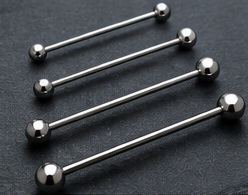
Wearable length is not overall length
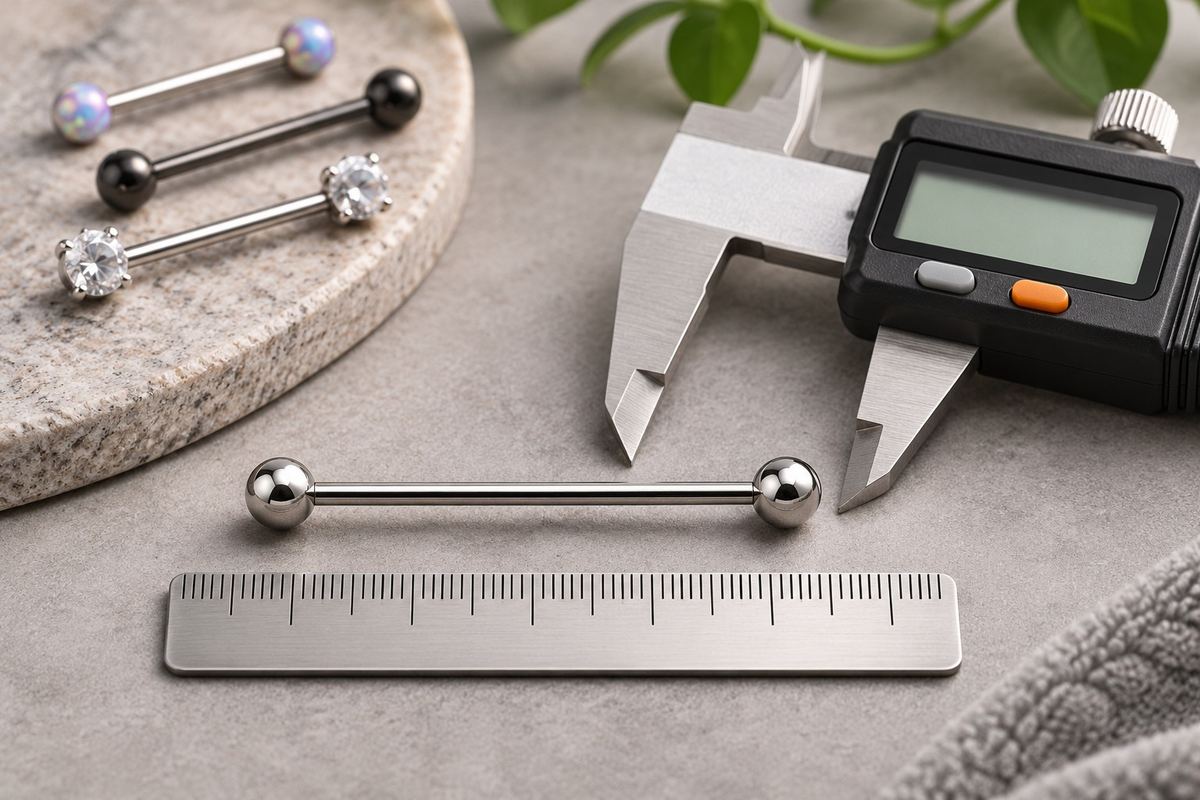
For an ordinary straight bar with terminal balls, wearable length usually refers to the exposed shaft between the inner surfaces of the ends. The overall length includes those ends. As an illustrative example, a 32 mm shaft with two 4 mm balls could have an outside dimension around 40 mm depending on how the components seat. That does not turn it into a 40 mm wearable bar. Suppliers may use different conventions, particularly for shaped ends or decorative centres. Use the product's dimension drawing or request clarification before ordering. The industrial length guide explores this distinction further and explains why comparing photos of bars on a ruler can be misleading.
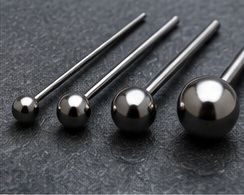
The two-hole geometry matters
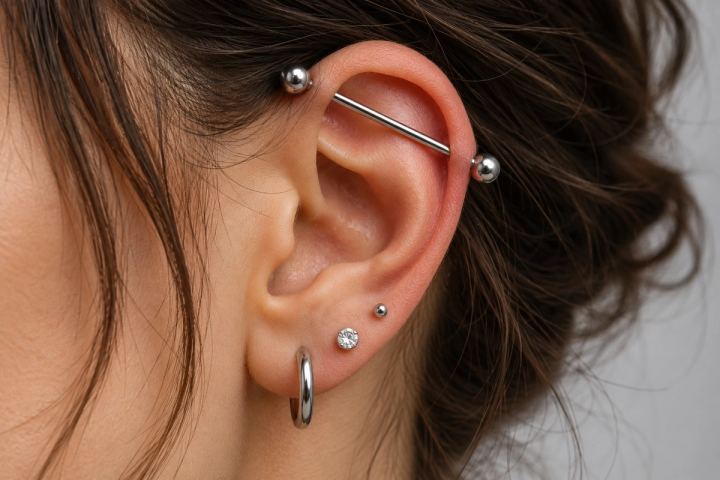
A conventional industrial requires a shared axis between two separate channels. A ruler laid along the visible outside of the ear cannot tell you that axis accurately. Nor can a single distance between the two external balls establish the angles through the cartilage. In addition, the bar must clear the surface between the holes. That clearance is not captured by a number for length alone. A professionally fitted bar can therefore be the better reference than an attempted ear measurement at home. If you have doubts about the placement, read industrial anatomy and arrange a fitting review rather than experimenting with different lengths.
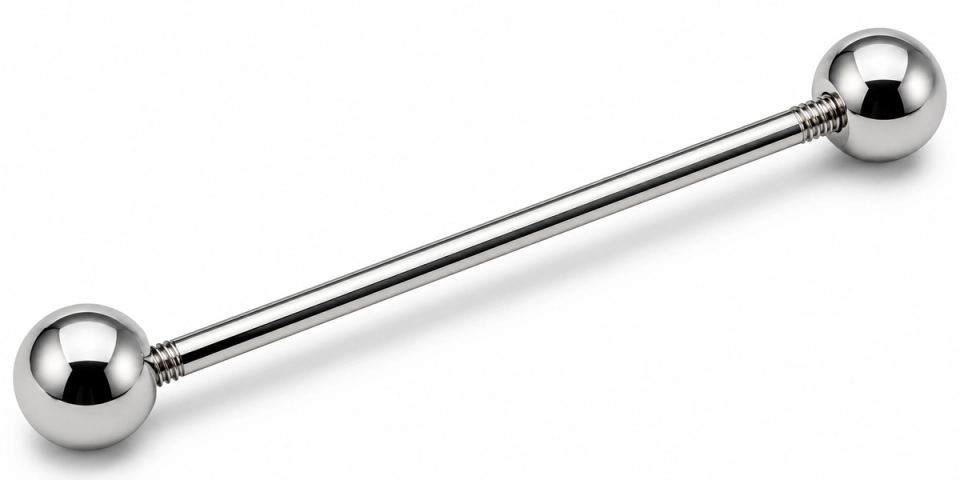
End dimensions change the practical fit
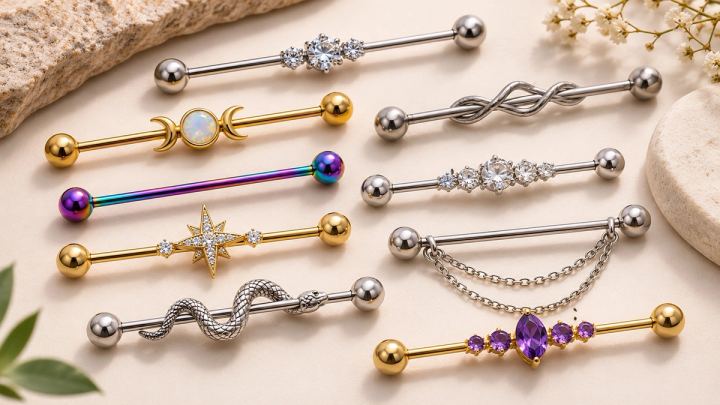
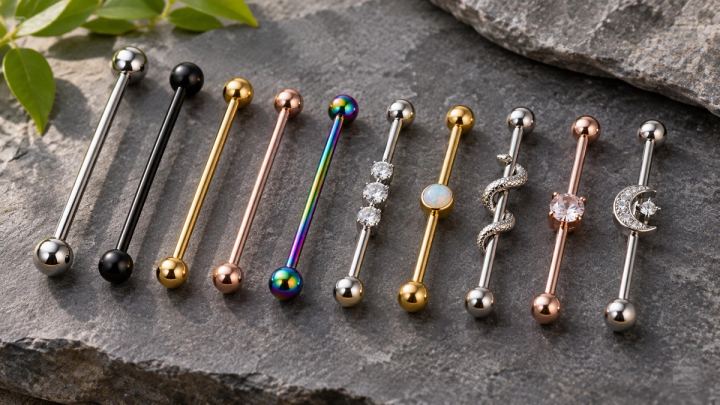
Small rounded ends and large sculpted ends are not equivalent, even if they attach to shafts of identical thickness and length. A larger end may touch an adjacent fold that the smaller end never reaches. A central gemstone setting may have a deeper backing than expected. Examine any available side-view photograph or technical drawing, and ask about the widest and deepest parts of the design. Compare your current piece to the proposed replacement at the same scale. In the industrial fit guide, we discuss how pressure, movement and contact with the middle of the ear can reveal a problem that the nominal measurements alone do not describe.
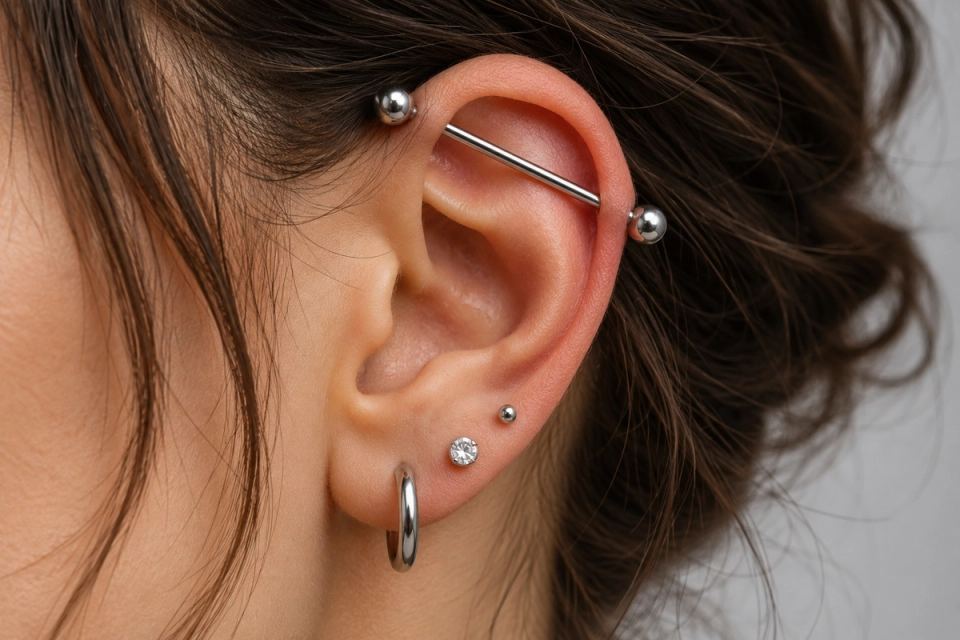
Document the size after professional assessment
A practical note can include the measured gauge, wearable length, end diameter or shape, attachment type, material and the date a piercer confirmed the fit. Keep the note with your purchase information. That gives you a reference when a shop's product name is vague or when a later listing uses inches rather than millimetres. If your piercing is still healing, the initial bar size may not represent the eventual established fit. Do not copy its length automatically when ordering a fashion replacement. Our complete industrial guide sets out the sequence from assessment to styling, and the broader ear sizing guide explains other jewellery formats.
Read listings as specifications rather than promises
A listing that states 14G but omits the wearable length provides only half of the basic measurement information. A listing that states a length without clarifying whether it includes the decorative ends also leaves an ambiguity. The supplied OUFER catalogue, for example, includes designs whose names reveal their gauge but not every fitting dimension. It would be inappropriate to infer a missing number from a similar item. Where a merchant documents the length, compare it with your professionally established size; where it does not, contact the seller. It is better to leave a product off a shortlist than buy a bar on the assumption that all industrials use identical measurements.
We may earn a commission through affiliate links. These examples are selected from supplied merchant specifications, not independently tested. Confirm current price, availability, material and fit before buying.
OUFER catalogue examples for established piercings

WICKED × OUFER Magic Broom Industrial Barbell
The feed describes a 38 mm sculpted broom design and claims ASTM F138 stainless steel. Confirm whether the stated length is wearable length, the gauge and the ornament's clearance.
Check price at OuferFrequently asked questions
Can I convert inches to millimetres?
Yes. One inch is 25.4 mm, but check whether the resulting number is wearable length or overall length.
Does 14G mean 14 mm?
No. Gauge is a thickness notation; 14G is about 1.6 mm.
Can a caliper decide whether I need a different bar?
A caliper can measure jewellery, but it cannot assess the suitability of your cartilage channels. Have a piercer evaluate fit.
Sources and further reading
Industrial Piercing Jewellery Library
Complete guide
Main guides
- Best Industrial Piercing Barbells
- Industrial Piercing Jewellery Materials: Titanium, Gold and Steel
- Industrial Piercing Jewellery Styles and Designs
Supporting guides
- Best Industrial Barbells for Everyday Wear
- Industrial Piercing Jewellery for Sensitive Ears
- Industrial Piercing Barbell Length Guide
- Industrial Piercing Gauge Guide: 14G vs 16G
- How Should an Industrial Piercing Barbell Fit?
- Titanium Industrial Piercing Jewellery
- Gold Industrial Piercing Jewellery
- Stainless Steel Industrial Piercing Jewellery
- Industrial Piercing Chain Jewellery
- Minimalist Industrial Piercing Jewellery
- Decorative Industrial Barbells: Gems, Opals and Charms
- Vertical Industrial Piercing Jewellery
- Industrial Piercing Anatomy: Will Your Ear Accommodate a Barbell?
- When Can You Change Industrial Piercing Jewellery?