Is gold-coloured jewellery solid gold?
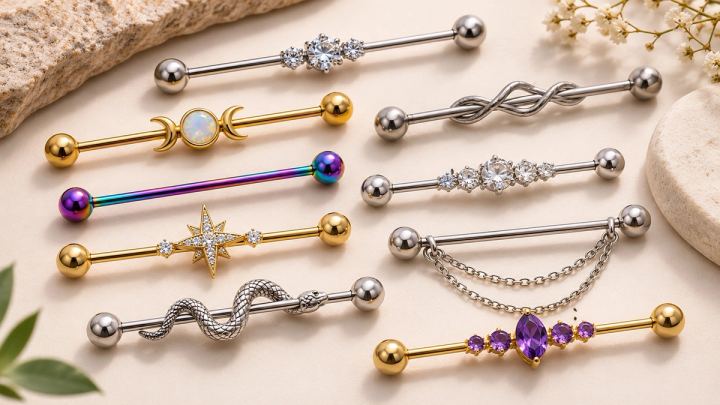
Gold industrial jewellery can mean a documented gold alloy or merely a gold-coloured finish. Establish the composition of the shaft and ends, whether any coating is present, and your fitted dimensions before choosing a piece.
Solid gold versus gold appearance
Gold content in a jewellery alloy is often described in karats or fineness. A 14-karat alloy, for instance, contains roughly 58.3 percent gold by weight, whereas 18 karats corresponds to 75 percent. These numbers do not specify the entire remaining composition, nor do they identify the material of every component. A gold-coloured stainless steel bar or an anodised titanium bar can share the warm appearance without having that gold content. The industrial material guide explains the different categories. When comparing listings, look for a clear statement about the shaft rather than assuming that a gold-coloured product photograph represents a precious-metal alloy.
What gold jewellery documentation should tell you
For jewellery that contacts a piercing, ask the supplier to describe the actual gold alloy, not just the finish. The Association of Professional Piercers discusses appropriate gold jewellery for initial placements, including suitable fineness and composition. Gold alloys vary, and an item sold for ordinary fashion use is not necessarily suitable for insertion into cartilage. For a decorated bar, ask separately about the shaft, the ends and the ornamental setting. A gold centrepiece mounted on a different metal bar should not be described as a solid gold bar without further information. Have your piercer assess the intended use before buying jewellery for a fresh or healing placement.
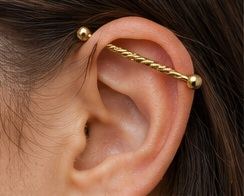
Gold-coloured coatings and anodised finishes
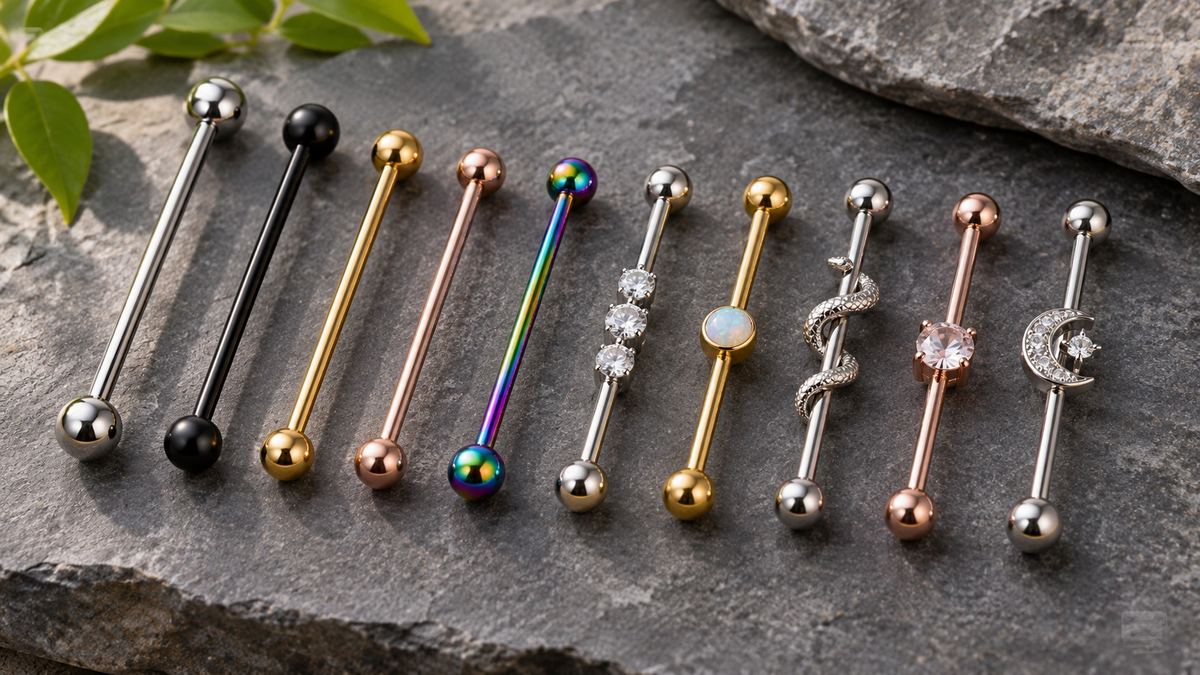
A surface treatment may be selected to create a particular shade or contrast. A coating applied over another metal is different from gold alloy throughout the piece, and anodised titanium has a different construction again. A listing may use terms such as gold tone without supplying enough information to determine which approach was used. Ask about the underlying material and the finish, including the areas that contact the piercing. Do not assume a coating eliminates every exposure associated with the underlying alloy. The titanium guide covers anodised colour and why it cannot be identified confidently from a picture alone.
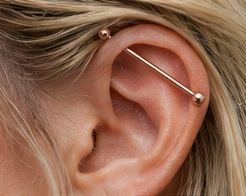
Choosing a warm-toned ear arrangement
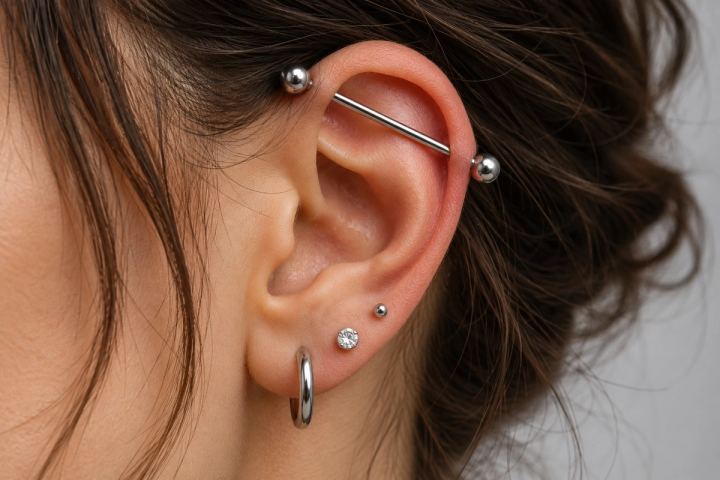
If your existing lobe jewellery is gold-coloured, an industrial with a matching finish can create a consistent appearance across the ear. Exact shade matching is more difficult than it might seem: yellow gold, rose gold tones and gold anodisation may look different in person. You can also use the bar as a deliberate contrast, with smaller silver-coloured pieces elsewhere. A simple warm-toned bar draws attention to the overall line, while a celestial or gemstone design makes the centre of the ear the focus. For more ideas on coordinating the profile rather than merely the colour, consult our industrial styles guide.
Keep fit separate from price and colour
A long gold bar should meet the same fitting requirements as a comparable silver-coloured piece. The appropriate shaft length, gauge and clearances do not change simply because you prefer a different material. A solid gold purchase may represent a larger financial commitment, so obtaining a reliable fitting record before ordering is particularly worthwhile. Ask whether the vendor offers the exact dimensions, what the fastening system is and whether individual replacement ends are available. Confirm what happens if the item is unsuitable before opening any hygienic packaging. See the industrial sizing guide for the measurements to discuss with your piercer.
Read the available catalogue honestly
The OUFER catalogue supplied for this guide includes a Moon and Sun Industrial Barbell labelled Gold. This is evidence of a gold-coloured variant, not evidence that the whole piece is made from solid gold. The feed does not establish an appropriate solid-gold industrial bar with verified alloy composition. A reader specifically seeking precious-metal jewellery should ask a qualified specialist for that documentation rather than treating the colour variant as a substitute. Our gold cartilage earring guide discusses related choices for other ear placements. Consider the catalogue example below as a style comparison for a healed piercing only, subject to fit and material confirmation.
We may earn a commission through affiliate links. These examples are selected from supplied merchant specifications, not independently tested. Confirm current price, availability, material and fit before buying.
OUFER catalogue examples for established piercings

OUFER Moon and Sun Industrial Barbell – Gold
Gold-coloured variant of the 14G celestial design. The feed does not establish that it is solid gold; ask for the shaft material and finish.
Check price at OuferFrequently asked questions
Does 14K mean the same thing as 14G?
No. Karat indicates gold content; gauge indicates shaft thickness.
Can a gold-coloured industrial be made of titanium?
Yes, for example through anodisation. Ask for documentation of the material and finish.
Sources and further reading
Industrial Piercing Jewellery Library
Complete guide
Main guides
- Best Industrial Piercing Barbells
- Industrial Piercing Jewellery Sizes and Measurements
- Industrial Piercing Jewellery Materials: Titanium, Gold and Steel
- Industrial Piercing Jewellery Styles and Designs
Supporting guides
- Best Industrial Barbells for Everyday Wear
- Industrial Piercing Jewellery for Sensitive Ears
- Industrial Piercing Barbell Length Guide
- Industrial Piercing Gauge Guide: 14G vs 16G
- How Should an Industrial Piercing Barbell Fit?
- Titanium Industrial Piercing Jewellery
- Stainless Steel Industrial Piercing Jewellery
- Industrial Piercing Chain Jewellery
- Minimalist Industrial Piercing Jewellery
- Decorative Industrial Barbells: Gems, Opals and Charms
- Vertical Industrial Piercing Jewellery
- Industrial Piercing Anatomy: Will Your Ear Accommodate a Barbell?
- When Can You Change Industrial Piercing Jewellery?