What is the difference between 14G and 16G?
14G is approximately 1.6 mm and 16G approximately 1.2 mm in common body jewellery sizing. They are thicknesses, not lengths. Use the gauge appropriate to your established piercing and do not change it without a piercer's assessment.
Read the notation correctly
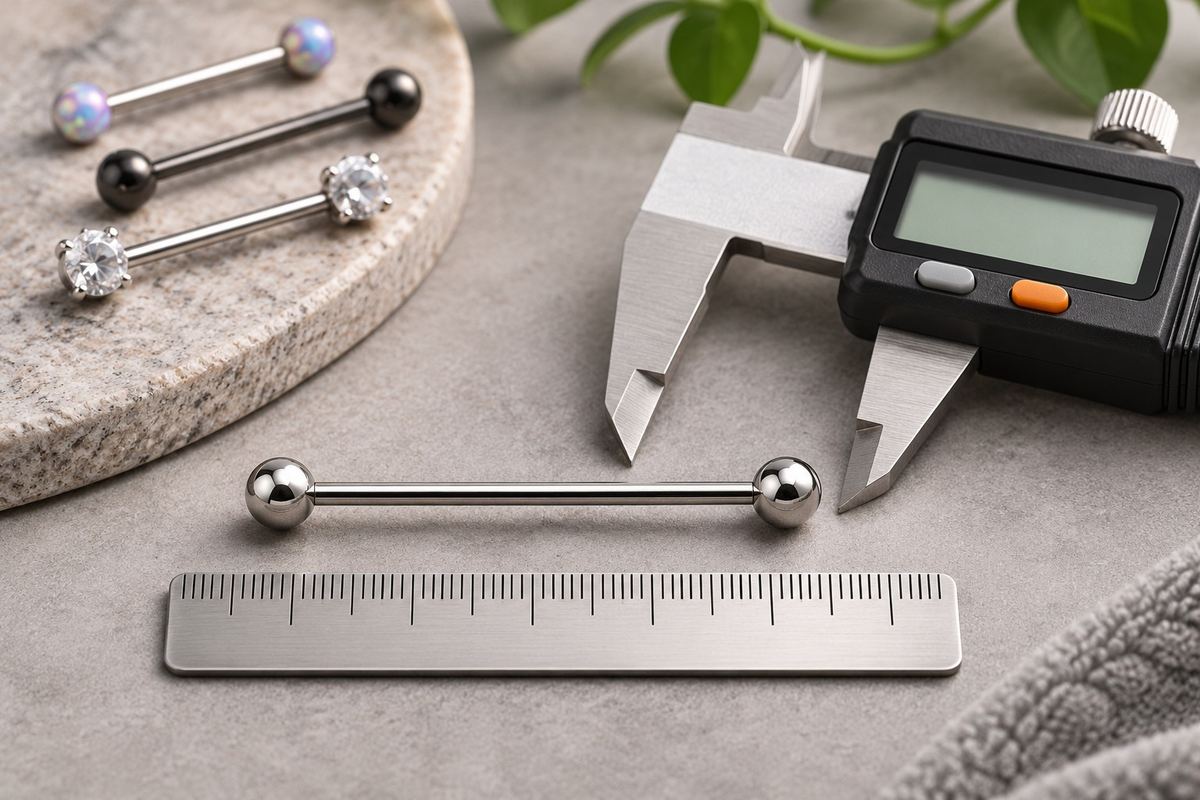
Gauge is a conventional size designation. In the commonly used body jewellery range, a lower gauge number indicates a thicker piece of jewellery. 14G corresponds to roughly 1.6 mm, while 16G corresponds to roughly 1.2 mm. These are rounded jewellery measurements; if precision matters, ask the supplier for its actual millimetre specification. Do not interpret 14G as fourteen millimetres, and do not confuse gauge with the length of the shaft. The industrial sizing pillar explains these two measurements together. A correctly described product should give enough information to identify both, along with any relevant attachment and end details.
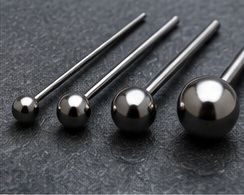
Why 0.4 mm is a meaningful difference
Although the numerical difference looks small, cross-sectional area varies with the square of diameter. A round 1.6 mm shaft has an approximate cross-section of 2.01 square millimetres; a 1.2 mm shaft has about 1.13 square millimetres. This geometric comparison helps explain why the visual difference in thickness is not trivial. It is not a calculation of the forces on your piercing, which depend on its placement, jewellery geometry and activities. Do not use the calculation to select a gauge for yourself. It simply shows that the two sizes should not be treated as interchangeable versions of the same bar.
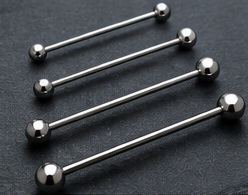
Both channels have to accommodate the jewellery
The industrial arrangement differs from a single cartilage stud because the straight shaft connects two sites. A thinner piece in a channel intended for a thicker one can change the way the jewellery is supported. A thicker piece cannot be assumed to fit a smaller channel safely. Never force a different gauge into an established piercing. If you are considering a gauge change for aesthetic reasons or because a particular product is available only in another thickness, discuss the idea with a qualified piercer first. A product catalogue is not a substitute for assessing the condition and geometry of the two channels.
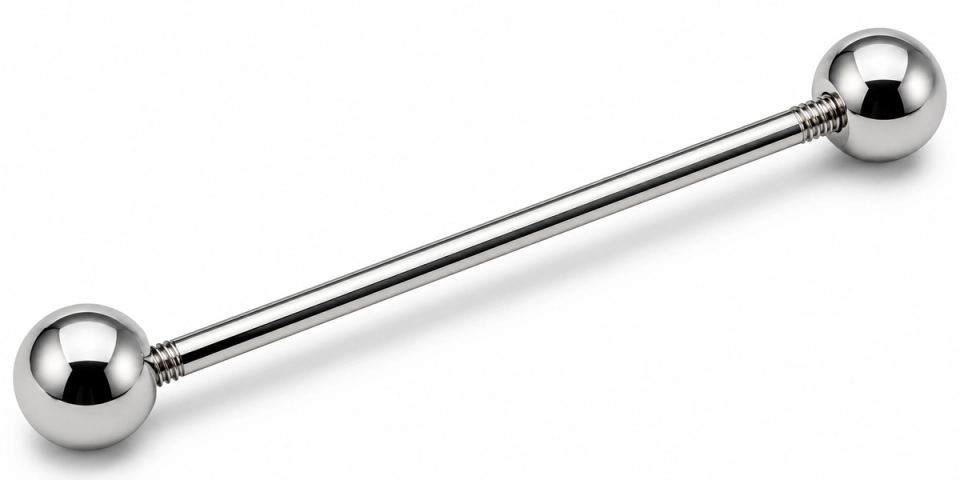
Gauge does not establish the strength of the assembly
It is tempting to conclude that a thicker bar must always be more durable. The complete piece also depends on the actual material, manufacturing quality, threading and design. A thin attachment or an ornamental joint may be a limitation even on a thicker shaft. The gauge number tells you the diameter of the wearable part, not the strength of every component. Similarly, a matching gauge does not prove that replacement ball ends from different manufacturers will attach correctly. Record the fastening method and supplier as well as the thickness. See industrial jewellery materials for the distinction between material labels and documented composition.
How to compare merchant variants
If a merchant sells a design in more than one gauge, select the exact variant when checking the specification. A product's main photograph may not reflect the size chosen in the selector. The supplied OUFER feed contains several industrial designs explicitly described as 14G, but it does not provide a complete set of dimensions for every one. That is a reason to confirm the length separately, not to infer the missing value. The length guide explains the independent measurement and why two pieces of the same gauge can have very different wearable lengths.
Make gauge part of a complete fitting record
A simple shopping note could say: gauge confirmed by piercer, wearable length confirmed by piercer, material grade, compatible ends and attachment system. It is particularly useful if you have several cartilage piercings of different gauges. A lobe or helix piece with the same finish as an industrial may use a different thickness and attachment. Store compatible parts together and avoid mixing unlabelled pieces. The industrial fit guide explains why the finished assembly must be assessed as a whole. If your current jewellery is uncomfortable or the piercing is not established, do not treat a gauge change as a home remedy.
We may earn a commission through affiliate links. These examples are selected from supplied merchant specifications, not independently tested. Confirm current price, availability, material and fit before buying.
OUFER catalogue examples for established piercings

OUFER Blue Butterfly Industrial Barbell
A blue butterfly centrepiece. The merchant claims ASTM F138 stainless steel in the feed and identifies 14G in the destination. Confirm documentation, usable length and the depth of the ornament.
Check price at Oufer
OUFER Simple Chain Industrial Barbell
A chain-decorated industrial identified as 14G, with 316L stainless steel in the merchant destination. Confirm shaft length, chain dimensions and material documentation.
Check price at Oufer
OUFER Star Industrial Barbell
The merchant identifies a 14G star design and lists 316L stainless steel in its destination. Verify the wearable length and clearance around the star.
Check price at OuferFrequently asked questions
Is 16G larger than 14G?
No. In this range the higher gauge number describes the thinner shaft.
Can I change to 16G because it looks more delicate?
Discuss that with a piercer rather than changing the gauge to suit a fashion preference.
Sources and further reading
Industrial Piercing Jewellery Library
Complete guide
Main guides
- Best Industrial Piercing Barbells
- Industrial Piercing Jewellery Sizes and Measurements
- Industrial Piercing Jewellery Materials: Titanium, Gold and Steel
- Industrial Piercing Jewellery Styles and Designs
Supporting guides
- Best Industrial Barbells for Everyday Wear
- Industrial Piercing Jewellery for Sensitive Ears
- Industrial Piercing Barbell Length Guide
- How Should an Industrial Piercing Barbell Fit?
- Titanium Industrial Piercing Jewellery
- Gold Industrial Piercing Jewellery
- Stainless Steel Industrial Piercing Jewellery
- Industrial Piercing Chain Jewellery
- Minimalist Industrial Piercing Jewellery
- Decorative Industrial Barbells: Gems, Opals and Charms
- Vertical Industrial Piercing Jewellery
- Industrial Piercing Anatomy: Will Your Ear Accommodate a Barbell?
- When Can You Change Industrial Piercing Jewellery?