
EAR PIERCING JEWELLERY
Titanium can be a good choice, but ask for evidence of the relevant implant material standard rather than relying on the word titanium. This guide focuses on practical selection, fit and the differences between jewellery designs.
Best Titanium Cartilage Earrings
Titanium can be a good choice, but ask for evidence of the relevant implant material standard rather than relying on the word titanium.
Material standards
ASTM F136 titanium alloy and ASTM F67 unalloyed titanium are examples of standards used in professional piercing jewellery. A retail title does not prove compliance.
Our cartilage buying guide compares the different placements so that the titanium material decision can be made within the appropriate shape.
Finish and assembly
A smooth surface and well-made closure are important even when the alloy is suitable. Check every component, including the pin, decorative top and hinge.
The titanium nose jewellery guide explains similar grade questions for nostril jewellery without transferring ear dimensions.

Colour and style
Titanium can be anodised to produce colour without implying gold content. A gold-coloured listing may also use a coating, so check the manufacturer’s explanation.
Compare a specification, not a keyword
A product name that includes titanium can refer to an unspecified titanium alloy, a documented implant-standard material or a component of a mixed-material assembly. The Association of Professional Piercers identifies particular standards for titanium used in initial jewellery, including ASTM F136 and F67. Those standards are not interchangeable with a generic marketing term. Ask the seller for the relevant documentation and whether it applies to the actual post or ring that will touch the channel.
There is a distinction between the supplier's material evidence and the finish of a manufactured piece. A smooth, appropriately finished shaft and a secure closure are essential characteristics even when the metal has suitable documentation. A rough seam, damaged surface or incompatible thread can create mechanical problems. When buying through a qualified piercer, discuss both the manufacturer's material evidence and its quality control for the finished jewellery.
Read our comparison of cartilage jewellery materials for the distinctions between titanium, gold, steel and niobium.
Choose a colour without guessing the coating
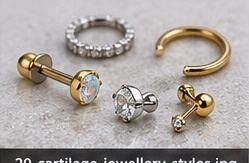
Anodised titanium can have colours including gold-like shades without being solid gold or gold plated. Other decorative finishes may involve coatings. A retailer's gold titanium description is ambiguous unless it explains the finish. If colour is important for your ear stack, ask how it was achieved and check whether the underlying metal specification is known. A gold-coloured photograph does not establish a particular coating or alloy.
A titanium post with a documented appropriate gold decorative top is another possible configuration. Check whether both components are included and whether the system is compatible. The backing or threaded part may use a different material from the front. Choosing this arrangement for a healed piercing can allow a coordinated look without buying a full solid-gold post, but the documentation for the shaft remains important.
Use material as one part of a fit decision
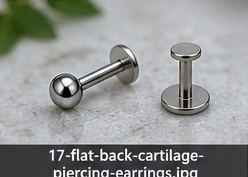
Titanium's relatively low mass can be appealing for some decorative designs. It cannot compensate for a post that is too short, a ring that pulls against the ear or an oversized setting that catches on hair. If a cartilage piercing is uncomfortable, check how the entire assembly interacts with the channel and surrounding anatomy. A change to titanium is not a treatment for infection. Seek appropriate medical care for suspected infection and arrange professional fit assessment for jewellery-related concerns.
When comparing two titanium listings, distinguish a seller's description of an anodised finish from evidence about the base metal. If a replacement top is offered separately, check the material of its pin or threaded attachment as well as the post. A colour match between two brands does not establish that they use the same connection. Keep the receipt and specification of a successful assembly so that a damaged component can be replaced without having to reconstruct the material and compatibility details from memory.
We may earn a commission through affiliate links. These examples use OUFER's listed specifications, not hands-on tests. Confirm current price, availability, material evidence and fit before buying.
OUFER product options to compare

16G CZ Segment Titanium Cartilage Hoop – 8 mm
The feed identifies a 16G titanium hoop with CZ decoration and an 8 mm variant. Ask for the titanium grade and confirm internal diameter and healed-placement clearance.
Check price at OuferBefore ordering: a practical fit checklist
| Check | What to confirm |
|---|---|
| Placement | Channel angle and surrounding cartilage clearance |
| Gauge | Matches the existing channel; do not force a thicker shaft |
| Length or diameter | Wearable post length or inside hoop opening, measured for your anatomy |
| Material | Documented alloy and finish of each component |
| Closure | Compatible ends and secure, smooth assembly |
For more detail see Ear Piercing Jewellery Size Guide and Best Jewellery for a Fresh Cartilage Piercing.
Frequently asked questions
What is the most important thing to check?
Titanium can be a good choice, but ask for evidence of the relevant implant material standard rather than relying on the word titanium.
Can I use a standard size chart to order?
Use a chart to understand measurements, not to determine your personal fit. A piercer can measure the channel and surrounding tissue.
Can I change jewellery while my piercing is healing?
Leave initial jewellery in place unless a qualified piercer or clinician recommends a change. Have any necessary downsizing performed professionally.
Professional references
Association of Professional Piercers: initial jewellery · APP aftercare guidance
Cartilage Piercing Jewellery Library
Complete guide
Main guides
- Best Cartilage Earrings
- Cartilage Piercing Jewellery Sizes: Gauge, Length and Diameter
- Best Materials for Cartilage Piercing Jewellery
- Cartilage Piercing Healing and Jewellery Aftercare
Supporting guides
- Best Helix Earrings and Jewellery
- Best Forward Helix Earrings
- Best Conch Earrings
- Best Tragus Earrings
- Best Daith Earrings
- Best Rook Piercing Jewellery
- Flat Piercing Jewellery: Styles and Placement
- Snug Piercing Jewellery Guide
- Best Solid Gold Cartilage Earrings
- Cartilage Hoop vs Stud: Which Should You Choose?
- Best Flat Back Earrings
- When Can You Change Cartilage Piercing Jewellery?
- Cartilage Piercing Bumps: Causes and Jewellery Problems