What makes a practical daily bar?
For everyday wear in a healed industrial, choose the professionally confirmed gauge and length, a low-profile design, securely attached ends and a documented material. Decorative pieces can be appropriate for occasional wear if the shape and fit are compatible.
The value of a simple reference bar
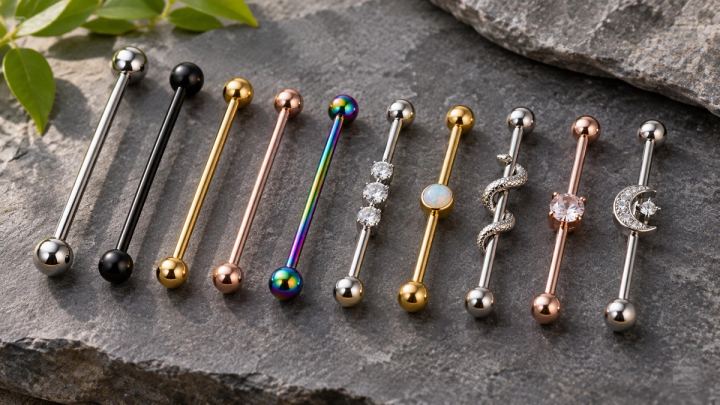
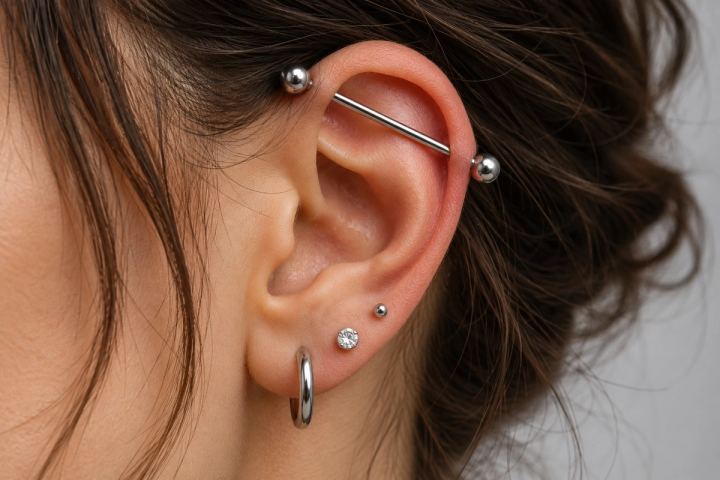
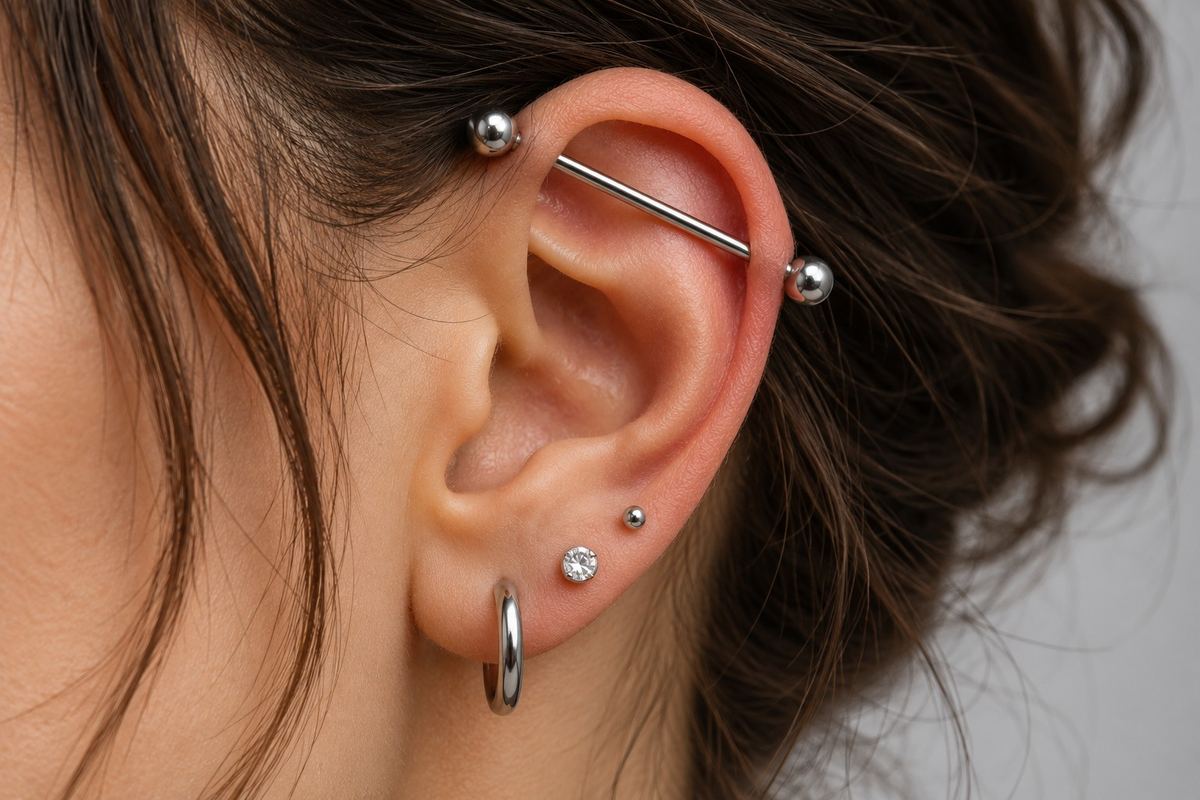
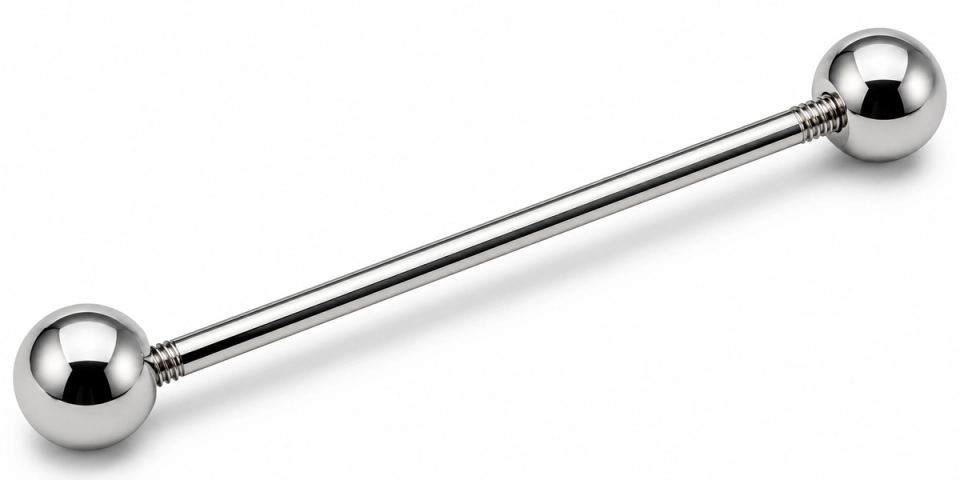
A straight bar with rounded ends is a sensible starting point for comparing profiles. It establishes how much space you actually need for the shaft and the terminal attachments. This does not mean every plain bar will fit or that decorative pieces are inherently unsuitable. A low-profile design merely introduces fewer variables than a long chain or a large sculpted centre. If the piece you already wear was professionally fitted, make a note of its dimensions before browsing replacements. The industrial barbell buying guide explains how to examine a listing for those details, including the distinction between end dimensions and wearable shaft length.
Hair, clothing and occupational equipment
Think about how often your hair crosses the industrial, particularly when washing or brushing it. A small protrusion may be inconsequential with short hair but frustrating if strands repeatedly catch around it. Hoods, knitted jumpers and towels present a similar problem. Workplace equipment deserves separate consideration: an industrial can occupy exactly the region where hearing protection or headset cushions rest. Do not solve that conflict by making an essential piece of protective equipment fit incorrectly. Discuss the placement and work requirements with a piercer and, where appropriate, the person responsible for workplace safety. A jewellery purchase should not compromise necessary protection.
Weight and the back of a design
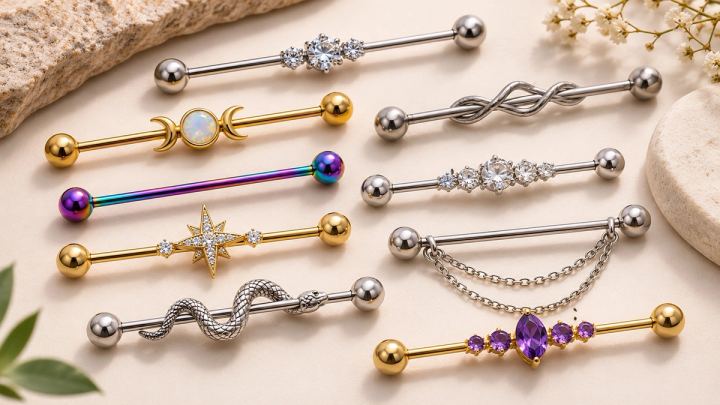
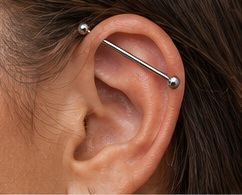
The front of a bar can be visually modest while its decorative backing projects surprisingly far. This is especially relevant to centrally mounted ornaments, whose depth may affect the space between the shaft and the ear. The larger the piece, the more meaningful its weight and balance can become. A heavier end or charm changes how the bar moves when you turn your head. Compare side views and mounting details before buying. If a listing shows only one glamour image, request the dimensions rather than assuming a low profile. Our fit guide discusses clearance and why an industrial must be evaluated across both cartilage channels.
Choose a finish that suits a repeat purchase
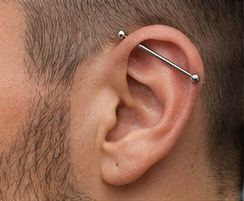
A useful everyday collection does not need ten pieces. One dependable size in a material documented by the supplier may be more useful than several attractive bars that cannot be worn comfortably. If you like a gold-coloured finish, establish whether it is an actual gold alloy, anodised titanium or another surface treatment. If you prefer silver-coloured jewellery, ask what the metal actually is. A clean, smooth finish where jewellery contacts tissue matters more than whether its appearance matches other accessories. The material guide helps you identify the information that should accompany a durable purchase.
Plan for activities rather than removing jewellery impulsively
Even established piercings can narrow when jewellery is removed, and an industrial has two channels that need to remain compatible with a single bar. If a sporting organisation, employer or healthcare provider requires jewellery removal, ask in advance how to manage that situation safely. A professional can advise on whether a different arrangement is appropriate. Do not repeatedly remove and force a bar back into channels that have tightened. An established piece that feels wrong should be assessed, not endured simply because it has been labelled everyday wear. If the piercing is not fully healed, defer fashion changes and follow your piercer's care instructions.
How to shortlist without unnecessary purchases
Start by writing down three characteristics of your routine: whether you need over-ear equipment, whether jewellery regularly catches in your hair or clothing, and whether you prefer a neutral or coordinated finish. Then reject designs whose dimensions are unknown or whose decorations would interfere with those activities. This leaves room for personal taste without sacrificing practical fit. A compact gemstone or a tiny fixed motif may work as an alternative to an entirely plain bar for some established piercings. The minimalist style guide explores ways to achieve a restrained look, while the jewellery change guide covers the timing of a replacement.
Frequently asked questions
Should I buy a shorter everyday bar to stop snagging?
Only after professional assessment. Reducing the length can introduce pressure if the new bar is too short.
Can I wear a chain every day?
It depends on fit, movement, activity and the condition of the piercing. A chain may catch more readily than a plain bar.
Sources and further reading
Industrial Piercing Jewellery Library
Complete guide
Main guides
- Best Industrial Piercing Barbells
- Industrial Piercing Jewellery Sizes and Measurements
- Industrial Piercing Jewellery Materials: Titanium, Gold and Steel
- Industrial Piercing Jewellery Styles and Designs
Supporting guides
- Industrial Piercing Jewellery for Sensitive Ears
- Industrial Piercing Barbell Length Guide
- Industrial Piercing Gauge Guide: 14G vs 16G
- How Should an Industrial Piercing Barbell Fit?
- Titanium Industrial Piercing Jewellery
- Gold Industrial Piercing Jewellery
- Stainless Steel Industrial Piercing Jewellery
- Industrial Piercing Chain Jewellery
- Minimalist Industrial Piercing Jewellery
- Decorative Industrial Barbells: Gems, Opals and Charms
- Vertical Industrial Piercing Jewellery
- Industrial Piercing Anatomy: Will Your Ear Accommodate a Barbell?
- When Can You Change Industrial Piercing Jewellery?