Which industrial barbell should you choose?
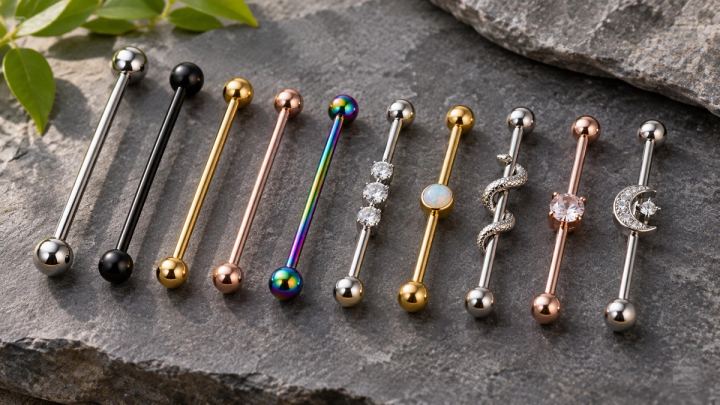
For an established industrial piercing, compare straight barbells by fit, finish, end design and clearance before considering decorative features. A simple bar is often the most practical benchmark; the best design for one ear is not necessarily the best for another.
Start with the bar you already wear
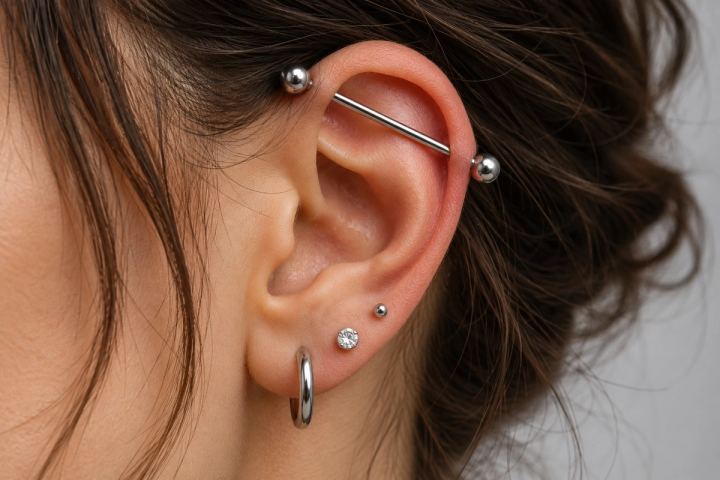
If your industrial has been fitted professionally, the current piece can be a valuable reference. Ask your piercer for its gauge and usable length rather than trying to estimate both from a photograph. Record the end shapes too. A replacement with the same nominal length can feel different if its ends are much larger or its decorative section protrudes backwards. The goal is to preserve a comfortable relationship between the two channels, not simply buy the longest bar you can find. Our complete industrial guide explains the connected placement and why the shaft needs clearance across the ear. Use that understanding before comparing any online catalogue.
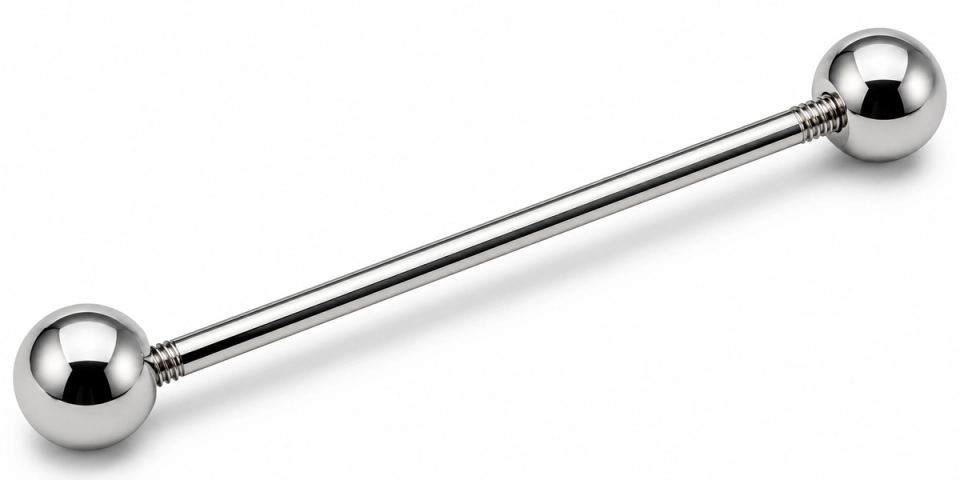
Plain ends versus decorative centres
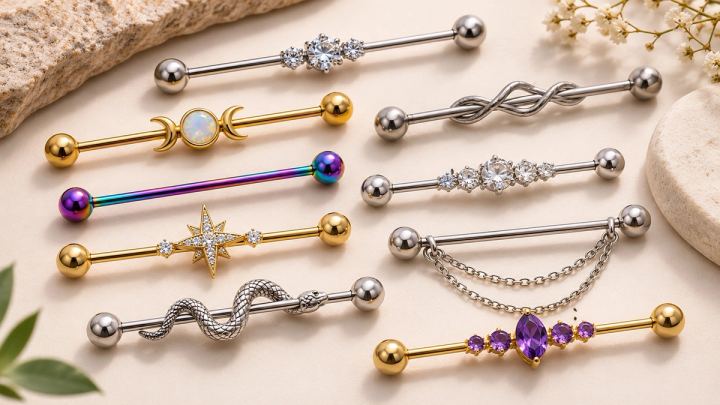
Plain ball ends provide a predictable silhouette. They do not have the same edges or projections as claws, stars or sculpted animal motifs. That can matter for people who change clothes frequently, wear hair loose or need to use equipment around the ear. A decorative centre has a different purpose: it becomes the main visual feature. Check both the front and back of the piece, including the setting, any movable parts and the way the ornament is attached to the shaft. If the ornament occupies much of the wearable length, the bar may not behave like the plain one of equal length. For a smaller collection built around routine use, see everyday industrial barbells.
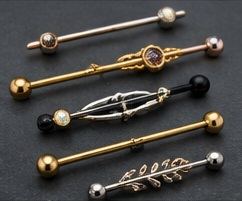
Compare the construction, not the advertising
Look for a supplier who specifies the material, size and fastening method. An internally threaded assembly has threads within the shaft rather than exposed external threads passing through the piercing. A threadless design uses a different fastening principle; compatibility between components cannot be assumed. The polished surface should be free from obvious irregularities, and an end should fit the shaft without an awkward exposed join. Product photography rarely proves the quality of the finish in areas that cannot be seen. Ask for details and, when possible, have a professional examine the piece before it is worn. The materials guide provides context for claims about steel, titanium and gold.
Consider your most demanding day
Think about the day when your jewellery is most likely to be inconvenient, rather than the day when it looks best in a mirror. A person who wears a headset at work may value compact ends; someone who wears a hood or changes a uniform several times might want fewer projections. A dramatic bar can be an excellent occasional choice for a fully established piercing, provided it actually fits. Compare the profile from the front and side rather than focusing only on sparkle. A product image showing a bar lying flat on a table cannot establish its suitability against the contours of your ear. Our guide to jewellery changes explains why even a tempting design should wait until the piercing is ready.
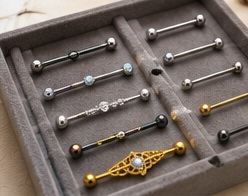
Compare catalogue choices by design
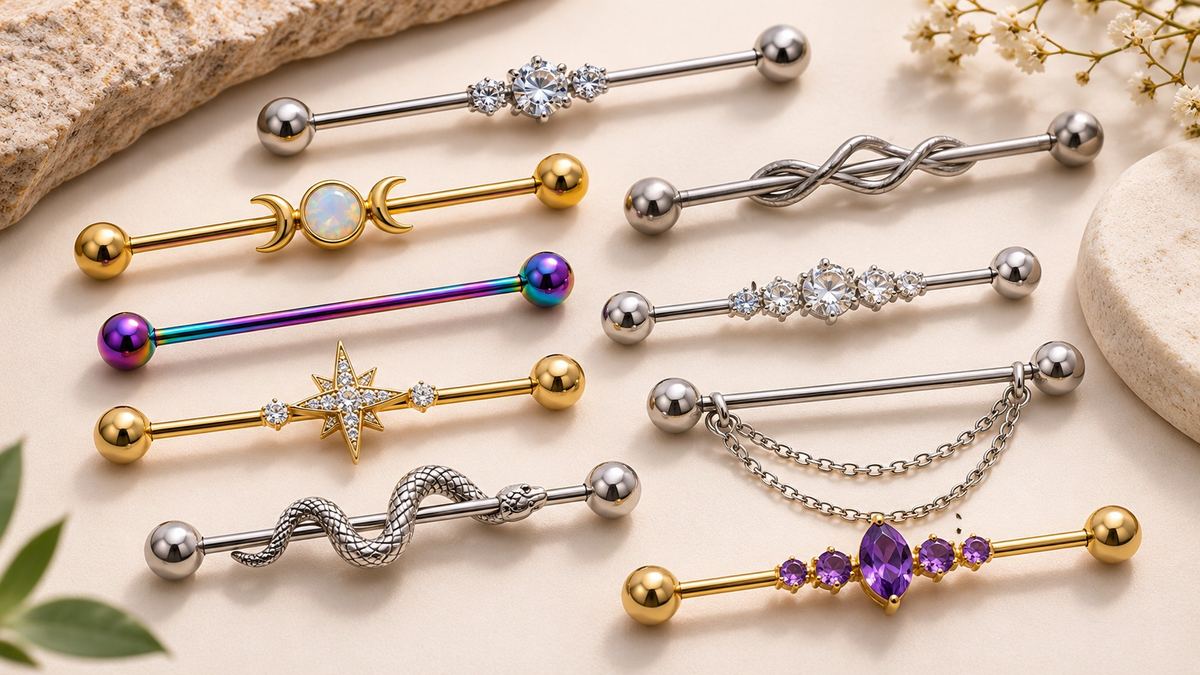
The OUFER catalogue contains several designs with very different silhouettes: a butterfly in the centre, a simple chain, celestial charms and more sculptural pieces. These are examples of design categories, not a claim that each is suitable for your placement. A small centrally mounted motif may be easier to coordinate with other jewellery, whereas a longer draped chain introduces movement. A strongly textured motif deserves particular attention to clearance and snagging. If the product listing omits the usable shaft length, do not infer it from the image or from the word industrial. Confirm it with the merchant and your piercer before buying. The size and measurement guide explains how to interpret the dimensions when they are supplied.
A practical shortlist
A useful shortlist starts with one simple piece whose dimensions you know, one alternative finish that you can document, and perhaps one occasion design if it fits your lifestyle. That is a more coherent collection than a large multipack of bars in unspecified sizes. Compare whether spare ends are available, whether the manufacturer identifies the threading system and whether returns are allowed before opening hygienically sealed products. For anyone shopping for an industrial as a gift, obtaining the recipient's fitted specifications is more thoughtful than guessing from ear size. The existing ear-cluster overview covers the broader jewellery context; this page is specifically about selecting the barbell.
We may earn a commission through affiliate links. These examples are selected from supplied merchant specifications, not independently tested. Confirm current price, availability, material and fit before buying.
OUFER catalogue examples for established piercings

OUFER Dragon Claw Industrial Barbell – 3PCS
The feed describes a three-piece decorative set featuring dragon-claw motifs and opal-style balls. The product destination specifies 14G; confirm each piece's usable length and actual material before ordering.
Check price at Oufer
OUFER Blue Butterfly Industrial Barbell
A blue butterfly centrepiece. The merchant claims ASTM F138 stainless steel in the feed and identifies 14G in the destination. Confirm documentation, usable length and the depth of the ornament.
Check price at Oufer
OUFER Simple Chain Industrial Barbell
A chain-decorated industrial identified as 14G, with 316L stainless steel in the merchant destination. Confirm shaft length, chain dimensions and material documentation.
Check price at Oufer
OUFER Star Industrial Barbell
The merchant identifies a 14G star design and lists 316L stainless steel in its destination. Verify the wearable length and clearance around the star.
Check price at Oufer
WICKED × OUFER Magic Broom Industrial Barbell
The feed describes a 38 mm sculpted broom design and claims ASTM F138 stainless steel. Confirm whether the stated length is wearable length, the gauge and the ornament's clearance.
Check price at Oufer
OUFER Skeleton Hands Industrial Barbell
The merchant describes skeleton hands, a red heart-shaped CZ and draped chains. Confirm the full size, material and clearance before considering this pronounced decorative design.
Check price at OuferFrequently asked questions
Is a 38 mm bar automatically the best choice?
No. A length listed by a merchant is a product specification, not a fitting recommendation.
Are decorative bars suitable for healing?
Do not use a fashion purchase as initial jewellery without professional assessment.
Do all replacement balls fit?
No. Thread size, connection design and manufacturer tolerances may differ.
Sources and further reading
Industrial Piercing Jewellery Library
Complete guide
Main guides
- Industrial Piercing Jewellery Sizes and Measurements
- Industrial Piercing Jewellery Materials: Titanium, Gold and Steel
- Industrial Piercing Jewellery Styles and Designs
Supporting guides
- Best Industrial Barbells for Everyday Wear
- Industrial Piercing Jewellery for Sensitive Ears
- Industrial Piercing Barbell Length Guide
- Industrial Piercing Gauge Guide: 14G vs 16G
- How Should an Industrial Piercing Barbell Fit?
- Titanium Industrial Piercing Jewellery
- Gold Industrial Piercing Jewellery
- Stainless Steel Industrial Piercing Jewellery
- Industrial Piercing Chain Jewellery
- Minimalist Industrial Piercing Jewellery
- Decorative Industrial Barbells: Gems, Opals and Charms
- Vertical Industrial Piercing Jewellery
- Industrial Piercing Anatomy: Will Your Ear Accommodate a Barbell?
- When Can You Change Industrial Piercing Jewellery?