EAR PIERCING JEWELLERY
Choose based on placement, healing and clearance rather than a universal rule that hoops or studs are better. This guide focuses on practical selection, fit and the differences between jewellery designs.
Cartilage Hoop vs Stud: Which Should You Choose?
Choose based on placement, healing and clearance rather than a universal rule that hoops or studs are better.
Movement and geometry
A hoop may rotate and move through a channel; a stud is relatively stationary when fitted appropriately. Both can cause pressure if undersized.
The cartilage earring guide compares placement-specific geometry; the helix earring guide gives an outer-rim example of the hoop-versus-stud decision.
Appearance and maintenance
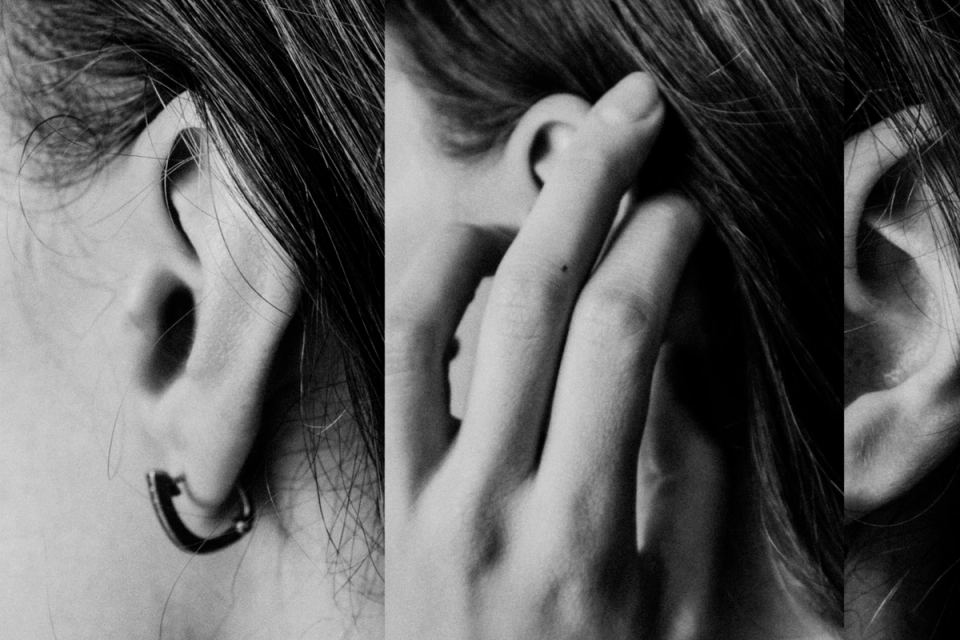
Hoops create a continuous line around cartilage; studs create discrete focal points. Decorative settings can snag regardless of style.

When to switch
A healed piercing and a professional assessment are the starting points for changing styles. Initial jewellery is selected for the individual anatomy and procedure.
Compare movement, not just appearance
A hoop's circular shape allows it to shift relative to the channel when the exposed part is contacted. The amount and direction of that movement depend on the ring's geometry, diameter, the channel angle and surrounding tissue. A post follows a straighter path, but its projecting end can act as a lever if caught. Neither design is automatically free of mechanical irritation. In a healed piercing, compare how the entire piece behaves during ordinary activities rather than assuming one category is inherently more comfortable.
Consider a conch and a helix as two distinct cases. A conch hoop must reach from the bowl around the outside rim, whereas a helix hoop may need a much smaller opening depending on the placement. In both cases, a too-tight ring may pull against the channel. A stud can be an appropriate choice where a ring does not have enough clearance, but its backing and length still need careful assessment.
Before switching shapes, read our cartilage sizing guide for the difference between post length and ring diameter.
Match the jewellery to your routine
An office headset can contact an outer helix differently from earbuds near a tragus or daith. A ring may move when a headphone cushion presses its exposed edge; a tall stud can project into the same cushion. The shape of the particular device matters as much as the jewellery category. If you have to wear headwear for work, bring it to a fitting appointment when practical. A change in decorative shape alone may not resolve pressure on the ear itself.
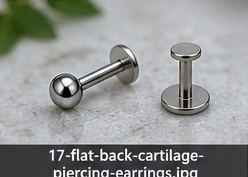
For sleeping, do not assume flat-back means safe to lie on a healing piercing. A disc behind the ear may be lower profile than some closures, but pressure still passes through the tissue. During healing, avoid pressure and follow professional advice. For a fully healed channel, a fitted everyday piece can be preferable to constantly alternating between shapes, especially if changing itself causes soreness.
Budget for the right size before experimenting
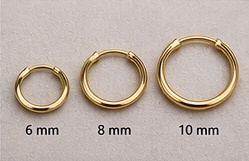
A trial purchase only makes sense once a piercer confirms the channel can accommodate the chosen shape. Record the gauge and post length for the existing stud, then obtain a separate assessment of the ring's required internal diameter. Buying a hoop with the same millimetre number as the post does not establish equivalent fit. For modular studs, check compatibility and the price of all required parts. It is perfectly reasonable to keep a comfortable stud indefinitely rather than treating a hoop as a necessary milestone.
If an ear has several healed channels, there is no requirement to use the same shape in each. A post in the flat can serve as the visual centre while a fitted helix ring frames the outside. A conch may remain a stud if wrapping a ring around the rim would create pressure. The visual combination is independent from the sizing decision for each channel. Make the choices separately, and do not assume that a complete matching set provides appropriate wearable dimensions for every placement.
We may earn a commission through affiliate links. These examples use OUFER's listed specifications, not hands-on tests. Confirm current price, availability, material evidence and fit before buying.
OUFER product options to compare

16G CZ Segment Titanium Cartilage Hoop – 8 mm
The feed identifies a 16G titanium hoop with CZ decoration and an 8 mm variant. Ask for the titanium grade and confirm internal diameter and healed-placement clearance.
Check price at Oufer
14K Gold CZ Flower Cartilage Earring
The merchant lists a 16G straight barbell, 8 mm length and 4 mm ball end, with a 14K solid-gold claim. Check the exact alloy and backing clearance.
Check price at Oufer
14K Gold Hinged Hoop Cartilage Earring – 8 mm
OUFER describes a 14K-stamped yellow gold hinged ring. Confirm alloy documentation and the internal diameter for your healed placement.
Check price at OuferBefore ordering: a practical fit checklist
| Check | What to confirm |
|---|---|
| Placement | Channel angle and surrounding cartilage clearance |
| Gauge | Matches the existing channel; do not force a thicker shaft |
| Length or diameter | Wearable post length or inside hoop opening, measured for your anatomy |
| Material | Documented alloy and finish of each component |
| Closure | Compatible ends and secure, smooth assembly |
For more detail see Ear Piercing Jewellery Size Guide and Best Jewellery for a Fresh Cartilage Piercing.
Frequently asked questions
What is the most important thing to check?
Choose based on placement, healing and clearance rather than a universal rule that hoops or studs are better.
Can I use a standard size chart to order?
Use a chart to understand measurements, not to determine your personal fit. A piercer can measure the channel and surrounding tissue.
Can I change jewellery while my piercing is healing?
Leave initial jewellery in place unless a qualified piercer or clinician recommends a change. Have any necessary downsizing performed professionally.
Professional references
Association of Professional Piercers: initial jewellery · APP aftercare guidance
Cartilage Piercing Jewellery Library
Complete guide
Main guides
- Best Cartilage Earrings
- Cartilage Piercing Jewellery Sizes: Gauge, Length and Diameter
- Best Materials for Cartilage Piercing Jewellery
- Cartilage Piercing Healing and Jewellery Aftercare
Supporting guides
- Best Helix Earrings and Jewellery
- Best Forward Helix Earrings
- Best Conch Earrings
- Best Tragus Earrings
- Best Daith Earrings
- Best Rook Piercing Jewellery
- Flat Piercing Jewellery: Styles and Placement
- Snug Piercing Jewellery Guide
- Best Titanium Cartilage Earrings
- Best Solid Gold Cartilage Earrings
- Best Flat Back Earrings
- When Can You Change Cartilage Piercing Jewellery?
- Cartilage Piercing Bumps: Causes and Jewellery Problems