Cartilage Piercing Bumps: Causes and Jewellery Problems
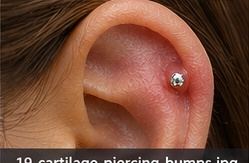
A bump around cartilage jewellery can have several causes, including irritation, tissue changes or infection. It cannot reliably be diagnosed from a photo. Ask a qualified piercer to assess jewellery fit and obtain urgent medical advice if you suspect infection or have increasing pain, heat, swelling, pus or feel unwell. Do not squeeze a bump or remove jewellery when infection is suspected unless a clinician advises it.
Do not assume every bump is a keloid
A small raised area around an entry or exit point is a description, not a diagnosis. There are several different types of tissue reaction, and online images may look similar even when the underlying causes differ. A true keloid is a particular kind of scar that requires appropriate clinical assessment. It is not a general name for every lump that appears around a piercing.
Notice how the symptoms have changed over time without repeatedly handling the area. A bump that appeared after a helmet began rubbing the upper ear has a useful history to share, but that does not establish that pressure is the only cause. If there are concerning symptoms, obtain medical advice rather than attempting to identify the lesion yourself. Do not delay assessment in the hope that changing to a different metal will solve it.
For everyday care and the role of a professional downsize, consult our cartilage healing and aftercare guide.

Investigate mechanical contact
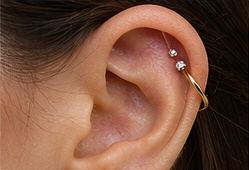
Cartilage jewellery can act as a small lever when it is caught. A long post may snag on a towel or hair, moving the ends relative to the channel. A ring that is too tight may transmit a persistent sideways force, and a decorative cluster can catch when a person removes a jumper. These are examples of mechanical conditions a piercer can evaluate. They are not reasons to immediately change the jewellery yourself.
Think through an ordinary day. Does a headset press against a helix for several hours? Does a sleeping position place the ear against a pillow? Do glasses pass close to a forward helix? Is a conch hoop pressed against the outer rim by the cushion of over-ear headphones? Reducing avoidable contact is a sensible precaution while arranging appropriate assessment. Even a low-profile design cannot eliminate pressure if the ear itself is compressed.
Review length and diameter
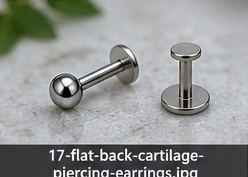
Initial jewellery may have been fitted with additional room for anticipated swelling. Once that room is no longer needed, a professional downsize may be appropriate. An excessively long post can move when something contacts its front or back. On the other hand, a post that is too short may compress tissue, leaving little accommodation for swelling. A fit check needs to consider both possibilities rather than automatically shortening the jewellery.
A hoop can create irritation if the opening does not suit the anatomy or if its seam repeatedly moves against the channel. Its gauge may be correct while its diameter is unsuitable. The same issue can arise with a curved barbell whose ends press into nearby folds. Ask your piercer to inspect the assembled piece, not just its advertised dimensions. If jewellery appears to be embedding, obtain prompt professional medical attention rather than trying to dig it out.
Consider material and surface quality
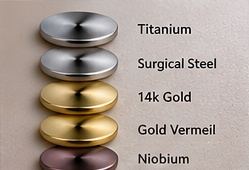
An unidentified alloy, a worn coating or a rough surface may contribute to discomfort. If you have the original packaging, bring it to the assessment. Record whether the piece was sold as a particular titanium grade, solid gold or a coated product and whether the specification applied to the shaft or only the top. Do not infer the composition from its colour.
It is possible for mechanical irritation and a reaction to a material to coexist. A better documented metal is not a treatment for an infection, and no commercial product can guarantee that a bump will disappear. If the piercer considers a replacement necessary during healing, let the professional choose and fit the appropriate piece. Repeated experimental changes may themselves cause additional irritation.
Avoid aggressive home remedies
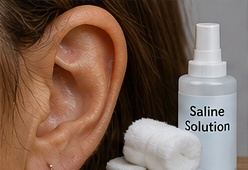
The Association of Professional Piercers recommends gentle wound care and avoiding unnecessary manipulation. Internet remedies may contain irritants or encourage rubbing, piercing or squeezing the raised area. Applying multiple preparations makes it harder to know whether the routine itself is causing trouble. Follow appropriate professional instructions, and avoid using jewellery advertised as a bump cure in place of assessment.
A photo record, taken without touching the ear, may help explain changes to a clinician or piercer. Note when symptoms began and what happened around that time. A useful description includes pain, warmth, swelling and whether there has been a change in discharge. If infection is suspected, the NHS recommends urgent medical help; increasing local symptoms or feeling feverish or unwell are important reasons not to wait.
Do not let a planned jewellery purchase delay care. If infection is not suspected and a professional identifies a straightforward fit issue, discuss how the channel can be protected during healing. If the problem persists or changes, seek clinical advice. The aim is to resolve the underlying condition, not to cover the raised area with a larger decorative front.
Frequently asked questions
Should I pop a cartilage bump?
No. Do not squeeze, puncture or pick at it. Obtain appropriate assessment.
Will titanium make a bump disappear?
No material can guarantee this. The underlying cause must be assessed.
When should I get medical help?
Seek urgent medical advice if infection is suspected, especially with worsening pain, heat, swelling, pus or feeling unwell.
Professional references
Cartilage Piercing Jewellery Library
Complete guide
Main guides
- Best Cartilage Earrings
- Cartilage Piercing Jewellery Sizes: Gauge, Length and Diameter
- Best Materials for Cartilage Piercing Jewellery
- Cartilage Piercing Healing and Jewellery Aftercare
Supporting guides
- Best Helix Earrings and Jewellery
- Best Forward Helix Earrings
- Best Conch Earrings
- Best Tragus Earrings
- Best Daith Earrings
- Best Rook Piercing Jewellery
- Flat Piercing Jewellery: Styles and Placement
- Snug Piercing Jewellery Guide
- Best Titanium Cartilage Earrings
- Best Solid Gold Cartilage Earrings
- Cartilage Hoop vs Stud: Which Should You Choose?
- Best Flat Back Earrings
- When Can You Change Cartilage Piercing Jewellery?