Cartilage Piercing Jewellery Sizes: Gauge, Length and Diameter
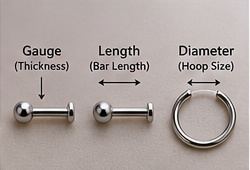
Gauge is shaft thickness, post length is the wearable distance between the ends, and ring diameter is usually the internal opening. Confirm all relevant measurements for your individual channel with a piercer. Common retail options are not universal anatomical sizes.
Translate the numbers correctly
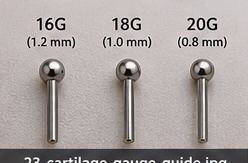
Gauge is a naming system in which a smaller gauge number generally corresponds to a thicker shaft. Typical retail descriptions include 16G (about 1.2 mm), 18G (about 1.0 mm) and 20G (about 0.8 mm). Some cartilage placements use other gauges. These figures describe the jewellery shaft, not the diameter of a gem, disc or ball. If two listings use different notation, compare the millimetre values rather than treating gauge as a length measurement.
A listing for 16G/8 mm may describe either a post or a ring. On a straight labret, 8 mm normally indicates the length of the wearable shaft; on a clicker ring, it commonly means the inner diameter. Neither tells you how large the front decoration will appear. Check the seller's measurement diagram and the selected variant. A product image showing several sizes may include pieces that are not actually in the basket.
The complete cartilage jewellery guide explains why each placement needs its own measured fit.
Measure posts and curved barbells
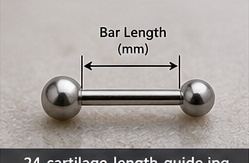
A flat-back post has a disc behind the ear and a removable or fixed end at the front. Wearable length is the gap available to the tissue, excluding the decorative top and backing. For an already removed piece of known fit, a ruler or calliper can help identify that dimension. Do not remove jewellery from a healing piercing merely to measure it. A piercer can establish both the gauge and the appropriate wearable length in person.
A curved barbell is a different geometry. Sellers commonly specify a measurement between its ends, but check whether the figure refers to a straight distance or the length along a curved shaft. Two bars described with similar numbers may have different curvature, so comparing only the number can be misleading. A rook or snug may need a particular shape to accommodate the fold without the ends pressing into nearby tissue. The decorative end diameter is an additional consideration.
The hoop-versus-stud comparison explains how the difference in geometry changes the fit decision, rather than treating equal millimetre values as interchangeable.
Understand inner hoop diameter
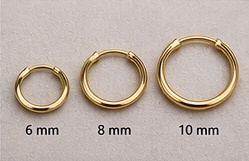
Inner diameter is the opening across the inside of a circular ring. Its outer diameter includes the shaft thickness on both sides, plus any decorative details that project beyond the ring. A ring advertised with a 10 mm outside width therefore need not have a 10 mm internal opening. When you need a close fit around a helix, this distinction is important because even a small change in internal clearance alters how the ring rests.
Conch hoops often need to reach around the outer rim from a channel positioned deeper in the bowl. A measurement appropriate for a helix does not establish a conch size. In addition to the distance from the channel to the ear edge, the direction of the channel matters. A piercer can evaluate how a particular ring sits without dragging the tissue sideways. Do not force a smaller hoop into a placement to obtain a tighter aesthetic.
For posts with removable ends, our flat-back earring guide explains the separate measurements and component compatibility.
Compare the complete assembled piece
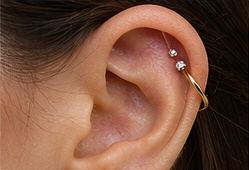
The front and back of a post influence comfort even when the shaft itself fits. A decorative cluster can overlap an adjacent stud, a large disc may press against an ear fold, and a high setting may catch on a helmet liner. Measure or compare the diameter of these components separately from the shaft. If you plan a flat arrangement with several decorative fronts, use the actual space between existing healed piercings as a starting point for the layout.
Threaded jewellery requires the correct thread size and design; threadless pieces require compatible pins and posts. A gauge match alone does not establish compatibility between two different brands. Confirm whether the selected option is a complete item, a decorative end or a replacement post. If a listing offers several configurations, the cheapest option might not include everything needed to wear the piece.
Know when a new measurement is needed
A piece that fitted when swelling was present may become excessively long later. Professional downsizing during healing can be appropriate, but the timing and replacement dimension should be decided with the piercer. Conversely, tight jewellery that leaves a persistent indentation, sinks into the skin or causes increasing discomfort needs assessment rather than waiting for the ear to adapt.
Record dimensions separately for every healed placement. If your right and left helix piercings sit at slightly different angles, they may need different ring diameters even if the same gauge was used. When a seller lists a size range, use it to identify candidates only after you know your required dimensions. A fit record is more valuable than a generic chart because it follows the actual channel you are buying for.
We may earn a commission through affiliate links. These examples use OUFER's listed specifications, not hands-on tests. Confirm current price, availability, material evidence and fit before buying.
OUFER product options to compare

16G CZ Hinged Segment Cartilage Ring – Silver / 7 mm
The selected variant is a silver-coloured stainless-steel CZ ring. The feed does not establish an implant-grade steel specification; check documentation and fit.
Check price at Oufer
14K Gold Hinged Hoop Cartilage Earring – 8 mm
OUFER describes a 14K-stamped yellow gold hinged ring. Confirm alloy documentation and the internal diameter for your healed placement.
Check price at Oufer
16G CZ Segment Titanium Cartilage Hoop – 8 mm
The feed identifies a 16G titanium hoop with CZ decoration and an 8 mm variant. Ask for the titanium grade and confirm internal diameter and healed-placement clearance.
Check price at Oufer
14K Gold CZ Flower Cartilage Earring
The merchant lists a 16G straight barbell, 8 mm length and 4 mm ball end, with a 14K solid-gold claim. Check the exact alloy and backing clearance.
Check price at OuferFrequently asked questions
Is 16G a standard size for every cartilage piercing?
No. It is a common option, but the gauge used depends on the piercing and professional assessment.
Can I measure jewellery in a fresh piercing?
Ask your piercer to establish the required size without removing the jewellery unnecessarily.
Professional references
Cartilage Piercing Jewellery Library
Complete guide
Main guides
- Best Cartilage Earrings
- Best Materials for Cartilage Piercing Jewellery
- Cartilage Piercing Healing and Jewellery Aftercare
Supporting guides
- Best Helix Earrings and Jewellery
- Best Forward Helix Earrings
- Best Conch Earrings
- Best Tragus Earrings
- Best Daith Earrings
- Best Rook Piercing Jewellery
- Flat Piercing Jewellery: Styles and Placement
- Snug Piercing Jewellery Guide
- Best Titanium Cartilage Earrings
- Best Solid Gold Cartilage Earrings
- Cartilage Hoop vs Stud: Which Should You Choose?
- Best Flat Back Earrings
- When Can You Change Cartilage Piercing Jewellery?
- Cartilage Piercing Bumps: Causes and Jewellery Problems