EAR PIERCING JEWELLERY
A conch stud sits within the ear bowl; a conch hoop must reach around the outer rim without pulling the channel. This guide focuses on practical selection, fit and the differences between jewellery designs.
Best Conch Earrings
A conch stud sits within the ear bowl; a conch hoop must reach around the outer rim without pulling the channel.
Inner conch versus rim clearance
The distance from the channel to the outer edge varies substantially. An inner diameter appropriate for a helix may be much too small for a conch. Ask your piercer to measure the path.
Compare the wider range of placements in the cartilage buying guide, then use the ear jewellery size guide to distinguish hoop diameter from post length.
Stud choices
A labret-style post may work in a suitable conch placement. Check the back disc and front end against ear anatomy and other piercings.

Hoop choices
A hinged ring can simplify closure for healed piercings, but the hinge and seam must not press into the channel. A multi-line design can be wider than a single ring and may need extra room.
The path from bowl to outer rim
A conch ring has to travel from the piercing in the bowl around the outside edge of the ear. It therefore needs to accommodate the relationship between the channel and the rim, not merely the thickness of the pierced cartilage. Two conches pierced at different distances from the edge can require noticeably different internal diameters. A ring may also sit differently depending on the direction of the channel. Ask a qualified piercer to assess that geometry before deciding on a close-fitting look.
A stud takes a more direct route through the tissue and does not have to wrap around the rim. It can provide a central focal point, particularly if the surrounding helix jewellery is minimal. The front must still clear the contours of the bowl and the backing needs space behind the ear. A large decorative setting can touch a nearby ridge or interfere with other jewellery. Consider both sides of the assembly rather than assuming a stud is automatically the more comfortable choice.
The cartilage earring buying guide compares conch options with other locations, while the dedicated sizing guide explains the difference between internal diameter and overall width.
Check how the hoop is constructed
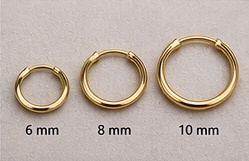
A plain circular hoop and a woven or gem-set hoop can have the same advertised inner diameter yet different external profiles. A wide decorative surface may rest against the outside edge when the ear is compressed by headphones. A hinge or seam should close securely and the surface needs a suitable finish. The placement of decoration also changes how much of the ring is visible from different angles.
Look for an explicit statement of the selected variant's inner diameter and gauge. Confirm that the quoted millimetres refer to internal clearance rather than overall width. Do not reduce the diameter just to achieve a tighter silhouette. If a hoop pulls at the channel, the appearance is being achieved at the expense of fit. A piercer may advise retaining a post if the channel angle is unsuitable for a ring.
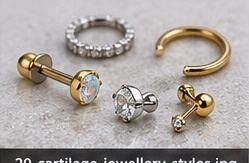
Plan a conch as part of a larger ear stack
For a healed conch, decide whether it will be the main visual feature or a smaller accent. A wide decorative ring can frame the ear while plain helix studs create contrast. A single gemstone in a conch stud may instead anchor a stack of small hoops around the rim. Select the dimensions of each piece independently and consider headphone contact before buying. A coordinated finish is easier to achieve than coordinated geometry, and the two should not be confused.
We may earn a commission through affiliate links. These examples use OUFER's listed specifications, not hands-on tests. Confirm current price, availability, material evidence and fit before buying.
OUFER product options to compare

14K Gold Woven Conch Earring – 10 mm
A woven-design ring listed in a 10 mm variant. Confirm the gauge, alloy documentation and clearance around your particular conch and rim.
Check price at Oufer
14K Gold Hinged Hoop Cartilage Earring – 8 mm
OUFER describes a 14K-stamped yellow gold hinged ring. Confirm alloy documentation and the internal diameter for your healed placement.
Check price at OuferBefore ordering: a practical fit checklist
| Check | What to confirm |
|---|---|
| Placement | Channel angle and surrounding cartilage clearance |
| Gauge | Matches the existing channel; do not force a thicker shaft |
| Length or diameter | Wearable post length or inside hoop opening, measured for your anatomy |
| Material | Documented alloy and finish of each component |
| Closure | Compatible ends and secure, smooth assembly |
For more detail see Ear Piercing Jewellery Size Guide and Best Jewellery for a Fresh Cartilage Piercing.
Frequently asked questions
What is the most important thing to check?
A conch stud sits within the ear bowl; a conch hoop must reach around the outer rim without pulling the channel.
Can I use a standard size chart to order?
Use a chart to understand measurements, not to determine your personal fit. A piercer can measure the channel and surrounding tissue.
Can I change jewellery while my piercing is healing?
Leave initial jewellery in place unless a qualified piercer or clinician recommends a change. Have any necessary downsizing performed professionally.
Professional references
Association of Professional Piercers: initial jewellery · APP aftercare guidance
Cartilage Piercing Jewellery Library
Complete guide
Main guides
- Best Cartilage Earrings
- Cartilage Piercing Jewellery Sizes: Gauge, Length and Diameter
- Best Materials for Cartilage Piercing Jewellery
- Cartilage Piercing Healing and Jewellery Aftercare
Supporting guides
- Best Helix Earrings and Jewellery
- Best Forward Helix Earrings
- Best Tragus Earrings
- Best Daith Earrings
- Best Rook Piercing Jewellery
- Flat Piercing Jewellery: Styles and Placement
- Snug Piercing Jewellery Guide
- Best Titanium Cartilage Earrings
- Best Solid Gold Cartilage Earrings
- Cartilage Hoop vs Stud: Which Should You Choose?
- Best Flat Back Earrings
- When Can You Change Cartilage Piercing Jewellery?
- Cartilage Piercing Bumps: Causes and Jewellery Problems