Flat Piercing Jewellery: Styles and Placement
A flat piercing commonly accommodates a professionally fitted flat-back stud. Its position on the upper ear can provide room for decorative fronts, but each piece needs an appropriate gauge, post length and backing clearance. Save larger decorative pieces for a fully healed channel and ask a piercer to assess fit.
Understand where the flat sits
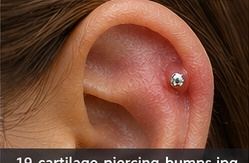
The flat occupies the upper cartilage surface inside the outer helix rim, in the region often called the scapha. Its exact position is selected according to your ear anatomy. A flat piercing is not simply another name for a helix piercing: it sits on a surface rather than along the outside edge, so a piece that works around the rim may not work in a flat. The front is visible from different angles depending on the direction of the channel and the contours of the ear.
Before choosing an elaborate design, look at the amount of usable space around the intended location. The decorative front may sit near the rim, a ridge or another piercing. Even if the visible surface looks broad, the back may not provide the same clearance. The piercer needs to consider both sides of the channel. A photo of a jewellery arrangement from the front cannot show whether its backing is comfortable or how the piece sits when someone wears glasses or lies down.
The cartilage earring buying guide compares flat studs with designs for other locations; the flat-back guide explains the interchangeable components.
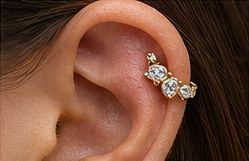
Choose the decorative footprint
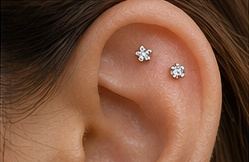
Small bezels and discs offer a simple visual accent. A narrow marquise, crescent or row of stones creates a longer shape that can follow the contour of the upper ear. A larger floral cluster makes the flat a focal point. These designs differ not only in diameter but also in height and weight. A tall setting may project far enough to catch on a comb even when its visible width seems modest.
If you have more than one healed flat piercing, compare the distance between their centres with the widths of the intended fronts. A large top and a smaller adjacent accent may create a balanced composition without their edges touching. A piece with an asymmetric shape may rotate depending on its construction and fit; check whether its appearance depends on maintaining a particular orientation. A piercer can help assess which settings will sit comfortably against your individual ear.
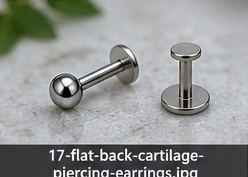
Check the post and back
The flat-back design uses a disc behind the ear and a decorative end at the front. Suitable post length depends on tissue thickness and the condition of the channel. The disc also needs clearance from nearby contours. A disc that sits against a ridge or a post that allows the decoration to tilt excessively can be uncomfortable even if the piece looks good from the front. Do not select a shorter post simply to make the top appear closer to the skin.
Threadless and internally threaded ends can be useful when the manufacturer provides compatible components. Read the variant details carefully. A beautiful gold top may be sold without its post; a cheaper listing may be a replacement end rather than a complete earring. Confirm gauge, post length, backing and compatibility together. If the piercer recommends changing the post during healing, have that fitting done professionally.
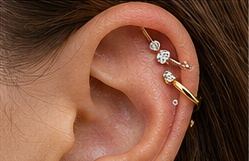
Plan around daily contact
The position of a flat piercing may bring it into contact with hairbrushes, towel edges, headwear and headphone cushions. Notice how often those items touch the upper surface of the ear. Someone who wears a headset for work may value a low-profile setting more than a tall decorative cluster. If your hair is long, consider a design without numerous exposed edges that could collect strands. No shape can make ongoing pressure on a healing channel harmless.
A healed flat can be combined with a helix or conch without making every piece equally prominent. Try establishing a single focal design and using smaller complementary fronts elsewhere. Match the visual finish if desired, but choose the wearable dimension independently at each piercing. If a design catches repeatedly or creates new soreness, stop treating it as an aesthetic problem alone and arrange a fit check. A comfortable everyday piece is a better foundation than a collection of decorations you rarely wear.
Buy for the healed placement, not the inspiration photo
Identify a top you like, then check its width, height, shaft material and component options. Ask a piercer whether the entire assembly fits the channel and surroundings. A product description containing the word cartilage does not guarantee suitability for the flat. If your placement is new, discuss future styling but retain the appropriate initial piece until professional advice supports a change.
We may earn a commission through affiliate links. These examples use OUFER's listed specifications, not hands-on tests. Confirm current price, availability, material evidence and fit before buying.
OUFER product options to compare

14K Gold Disc Threadless Cartilage Nose Stud – Top only / 1.5 mm
This exact variant is a 1.5 mm decorative top only, not a complete stud. Confirm compatible threadless post, gauge, length and material separately.
Check price at Oufer
14K Gold CZ Flower Cartilage Earring
The merchant lists a 16G straight barbell, 8 mm length and 4 mm ball end, with a 14K solid-gold claim. Check the exact alloy and backing clearance.
Check price at OuferFrequently asked questions
Is a flat piercing the same as a helix?
No. They occupy different areas of the upper cartilage and may need different jewellery geometry.
Can I wear a hoop in a flat?
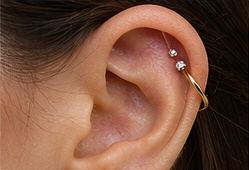
A hoop is not the usual default for this position. A piercer should assess the particular anatomy and channel before suggesting an alternative to a fitted stud.
Professional references
Cartilage Piercing Jewellery Library
Complete guide
Main guides
- Best Cartilage Earrings
- Cartilage Piercing Jewellery Sizes: Gauge, Length and Diameter
- Best Materials for Cartilage Piercing Jewellery
- Cartilage Piercing Healing and Jewellery Aftercare
Supporting guides
- Best Helix Earrings and Jewellery
- Best Forward Helix Earrings
- Best Conch Earrings
- Best Tragus Earrings
- Best Daith Earrings
- Best Rook Piercing Jewellery
- Snug Piercing Jewellery Guide
- Best Titanium Cartilage Earrings
- Best Solid Gold Cartilage Earrings
- Cartilage Hoop vs Stud: Which Should You Choose?
- Best Flat Back Earrings
- When Can You Change Cartilage Piercing Jewellery?
- Cartilage Piercing Bumps: Causes and Jewellery Problems