Best Materials for Cartilage Piercing Jewellery
Documented implant-standard titanium is often a practical option, especially when nickel sensitivity is a concern. Appropriate solid gold alloys, certain documented steels and niobium can also be suitable in the right circumstances. A qualified piercer should choose initial jewellery; a material name or colour alone is not proof of quality.
Read the evidence behind the material name
Titanium is not a single specification. The Association of Professional Piercers identifies particular standards, including ASTM F136 and F67, among the accepted material specifications for initial jewellery. A seller who simply writes titanium in the title has not established that the product meets one of those standards. Ask what documentation is available for the specific item, rather than relying on an unrelated statement elsewhere in the shop.
The same issue arises with steel. Surgical steel describes a broad family of alloys and does not guarantee that a particular piece is appropriate for contact with a healing channel. Certain documented grades meet accepted specifications, but a vague steel listing should not be treated as equivalent to certified stock. For nickel-sensitive customers, the alloy and relevant evidence matter more than the polished silver appearance.
Material is one part of the selection process described in the complete cartilage jewellery guide.
Compare titanium, niobium and gold
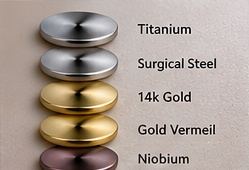
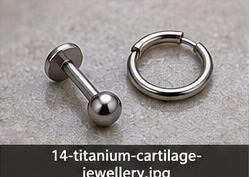
Titanium offers a relatively low mass for its strength, which can be useful for jewellery with larger fronts. A properly finished titanium item need not be limited to a plain silver colour. Anodising can produce a range of colours through a surface effect rather than applying a gold coating. The resulting appearance does not establish material grade; you still need documentation for the underlying metal.
Niobium is another metal used in body jewellery, with its own colour possibilities. It is not automatically equivalent to implant-certified titanium and should not be described as carrying the same implant-grade designation. Solid gold is a separate choice. Appropriate gold alloys must be considered alongside the karat and the presence of potentially unsuitable alloying metals. A gold finish on another material, gold-filled construction and solid gold are different descriptions.
For specific titanium examples and documentation questions, use our titanium cartilage earring guide.
Look at the parts that touch the channel
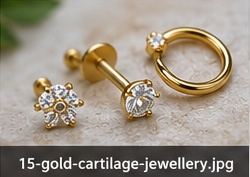
A listing can advertise a solid gold decorative end even though the post is made from another metal. This may be entirely intentional, especially with interchangeable threadless assemblies. Determine whether the front, shaft, backing and any threaded insert are described individually. If the post touches tissue, the post's specification is essential information even when the visible top is the costly component.
Pay attention to the finish of the shaft and the transitions between components. A rough joint, projecting seam or poorly finished surface can make a documented material unsuitable as a finished piece. A securely seated gemstone with a smooth setting can be easier to wear than an intricate piece with exposed edges. Product photographs sometimes show the front beautifully while revealing very little of the shaft or closure.
When comparing gold tops, complete assemblies and finishes, see the solid gold cartilage earring guide.
Decide when a coating is appropriate
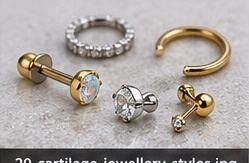
Coated jewellery can be visually attractive, but a coating changes the surface that comes into contact with the body. Friction or wear may reveal the substrate. Gold-coloured products should not automatically be classified as gold, and a coating described with a technical marketing term does not tell you everything about its composition or durability. Ask about the substrate, the surface process and whether the manufacturer specifically supports the intended piercing use.
For a healed piercing, changing the visual palette may be the reason to consider a different finish. Keep that decision separate from selecting initial jewellery for a healing channel. If you want a durable gold appearance, compare documented appropriate solid gold with anodised titanium rather than assuming all yellow metals behave in the same way. The budget should include a correctly fitted complete assembly and not only its decorative front.
Make a material purchase checklist
Start with your known sensitivities and the actual type of piercing. Request the metal specification, check what the selected variant includes, and review the finish and closure. If the seller supplies a certificate, make sure it refers to the relevant material and ask how it relates to the item. A reputable piercer can help interpret documentation and source suitable initial jewellery when a retail description is incomplete.
When discomfort develops, do not immediately conclude that it is a metal allergy. A short post, long post, movement, nearby pressure and cleaning habits can also contribute. An allergy or infection requires the appropriate assessment; changing to an expensive metal is not a diagnostic test. Record which pieces you tolerated comfortably in healed channels, while recognising that the material is only one part of fit and wear.
We may earn a commission through affiliate links. These examples use OUFER's listed specifications, not hands-on tests. Confirm current price, availability, material evidence and fit before buying.
OUFER product options to compare

16G CZ Segment Titanium Cartilage Hoop – 8 mm
The feed identifies a 16G titanium hoop with CZ decoration and an 8 mm variant. Ask for the titanium grade and confirm internal diameter and healed-placement clearance.
Check price at Oufer
14K Gold Hinged Hoop Cartilage Earring – 8 mm
OUFER describes a 14K-stamped yellow gold hinged ring. Confirm alloy documentation and the internal diameter for your healed placement.
Check price at Oufer
16G CZ Hinged Segment Cartilage Ring – Silver / 7 mm
The selected variant is a silver-coloured stainless-steel CZ ring. The feed does not establish an implant-grade steel specification; check documentation and fit.
Check price at Oufer
14K Gold Disc Threadless Cartilage Nose Stud – Top only / 1.5 mm
This exact variant is a 1.5 mm decorative top only, not a complete stud. Confirm compatible threadless post, gauge, length and material separately.
Check price at OuferFrequently asked questions
Is 14K gold always suitable?
No. Karat indicates gold proportion, not the full alloy, finish or suitability for a particular piercing.
Is anodised titanium gold plated?
No. Anodising produces colour through the surface oxide layer; check the underlying titanium specification.
Does hypoallergenic prove an implant standard?
No. Ask for the actual alloy and relevant documentation.
Professional references
Cartilage Piercing Jewellery Library
Complete guide
Main guides
- Best Cartilage Earrings
- Cartilage Piercing Jewellery Sizes: Gauge, Length and Diameter
- Cartilage Piercing Healing and Jewellery Aftercare
Supporting guides
- Best Helix Earrings and Jewellery
- Best Forward Helix Earrings
- Best Conch Earrings
- Best Tragus Earrings
- Best Daith Earrings
- Best Rook Piercing Jewellery
- Flat Piercing Jewellery: Styles and Placement
- Snug Piercing Jewellery Guide
- Best Titanium Cartilage Earrings
- Best Solid Gold Cartilage Earrings
- Cartilage Hoop vs Stud: Which Should You Choose?
- Best Flat Back Earrings
- When Can You Change Cartilage Piercing Jewellery?
- Cartilage Piercing Bumps: Causes and Jewellery Problems