Snug Piercing Jewellery Guide
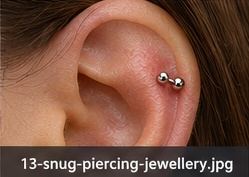
A snug piercing commonly uses an appropriately fitted curved barbell. It passes through the antihelix ridge, and suitability depends strongly on anatomy, placement and the available space around both ends. Have a qualified piercer assess the channel, especially before selecting initial jewellery or considering a ring.
Know what makes the snug different
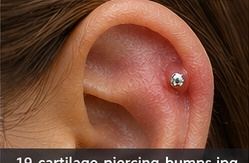
The snug sits across a raised inner ridge of cartilage rather than the outer helix rim or the bowl of the conch. Both visible ends can occupy a compact area of the ear, so the relationship between the curve of the bar and the shape of the ridge matters. It is not enough for a listing to describe a piece as a cartilage barbell. The shaft geometry and the space available for the ends must work together.
The anatomy required for a snug is not present in every ear. A piercer may advise against the placement after assessing the prominence and thickness of the ridge. That is a fitting decision, not a reason to search for a smaller piece in the hope of making it possible. If you like the visual effect but your ear is not suitable for a true snug, discuss professionally planned alternative placements. Separate piercings can sometimes create a similar composition, but each has its own channel and jewellery needs.
For the broader selection by ear anatomy, read the cartilage earring buying guide. For another type of inner cartilage ridge, compare our rook jewellery guide.
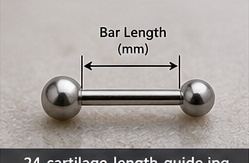
Compare curved barbell geometry
The common starting point for snug jewellery is a curved shaft with two ends. A curved bar described as 8 mm is not necessarily identical to another bar of the same nominal length: the curve and end dimensions may differ. Ask the seller how length is defined and whether the measurement excludes the decorative ends. More importantly, ask your piercer which geometry is appropriate for the channel. Do not choose a generic curved bar solely because its listing includes the word rook or eyebrow.
A decorative ball or gemstone can occupy more space than the shaft suggests. Check whether each end will rest clear of the surrounding ear folds, and whether it projects into the area that touches a headphone or pillow. A large top can obscure the visual effect of the snug by hiding the ridge rather than framing it. A simple, modest pair of ends may work well visually in a healed placement because both sides remain visible.
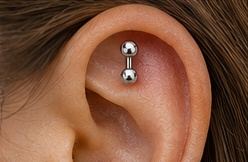
Allow room for a professional fitting
Initial swelling and later changes in tissue can affect the wearable dimension needed for a snug. A piercer selects a piece with appropriate accommodation and may recommend a later professional downsize. Do not try to shorten the bar yourself while the channel is healing or use a snug fit as a test of progress. Persistent pressure, an end sinking into the tissue, or a marked increase in pain needs assessment.
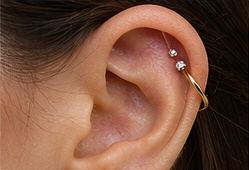
A ring creates a different path and transmits movement differently from a curved barbell. It may not be suitable for the particular snug placement even after healing. If you want the appearance of a ring, ask a piercer to evaluate the angle and clearance first. Do not force a ring through a channel because its gauge appears to match. A matching thickness is only one part of compatibility.
Consider habits before choosing a design
The snug lies in an area that may be affected by pressure from over-ear headphones or sleeping on the pierced side. Try to identify which items contact that ridge in daily life. Even a small piece may become uncomfortable if the entire ear is repeatedly pressed against a hard surface. A low-profile end can reduce projection, but it does not remove pressure on the cartilage itself.
Keep the focus on comfortable wear rather than constant changes. A snug can be visually effective with a plain barbell alongside smaller studs elsewhere in the ear. Once fully healed, modest variations in the end style may create a different look without demanding an entirely different jewellery shape. Only consider compatible ends and confirm that the assembled piece retains a suitable finish and fit.
Know what a product listing can and cannot tell you
A useful listing identifies material, gauge, wearable dimension and end design. If it does not specifically document suitability for the snug, regard it as a possible shape to discuss with a professional, not as a confirmed recommendation. We do not present a generic curved barbell as snug-specific solely because it looks similar. When a product description lacks the necessary detail, obtaining a measured piece through a qualified piercer may be more useful than guessing online.
Frequently asked questions
Can everyone get a snug piercing?
No. A qualified piercer needs to assess the antihelix anatomy and available space.
Can I use a rook barbell in a snug?
Not automatically. Gauge, curve, length and end clearance must all suit the snug channel.
Can I switch to a ring as soon as swelling disappears?
No. Swelling settling does not establish full healing or ring suitability. Ask your piercer to assess both.
Professional references
Cartilage Piercing Jewellery Library
Complete guide
Main guides
- Best Cartilage Earrings
- Cartilage Piercing Jewellery Sizes: Gauge, Length and Diameter
- Best Materials for Cartilage Piercing Jewellery
- Cartilage Piercing Healing and Jewellery Aftercare
Supporting guides
- Best Helix Earrings and Jewellery
- Best Forward Helix Earrings
- Best Conch Earrings
- Best Tragus Earrings
- Best Daith Earrings
- Best Rook Piercing Jewellery
- Flat Piercing Jewellery: Styles and Placement
- Best Titanium Cartilage Earrings
- Best Solid Gold Cartilage Earrings
- Cartilage Hoop vs Stud: Which Should You Choose?
- Best Flat Back Earrings
- When Can You Change Cartilage Piercing Jewellery?
- Cartilage Piercing Bumps: Causes and Jewellery Problems