When Can You Change Cartilage Piercing Jewellery
Wait until your cartilage piercing has healed and your piercer confirms it is ready before changing jewellery for appearance. Cartilage commonly needs many months, and sometimes longer. A professional downsize may be appropriate earlier, but that is not permission to change jewellery at home while healing.
Understand the two kinds of jewellery change
The initial piece is selected to accommodate the wound and anticipated changes in tissue. Its dimensions may no longer be ideal as swelling decreases. A qualified piercer can evaluate whether a shorter or differently fitted piece would reduce unnecessary movement. Such a change is part of managing the fit of a healing piercing, not an elective fashion change.
A style change has a different purpose. You may want to replace a plain post with a decorative front, change to a hoop or coordinate a healed piercing with the rest of an ear stack. These choices do not have the same urgency as correcting unsuitable jewellery. Wait for professional advice that the channel is ready. Even if you intend to use the same material and gauge, manipulation can still disturb a channel that is not fully healed.
Read our healing and aftercare guide for gentle care and professional follow-up during the healing period.

Why the calendar cannot decide on its own
Many people look for a date on which cartilage jewellery can be changed. Healing varies according to the piercing location, the person's circumstances and any recurring pressure or injury. A single time estimate cannot account for every ear. The outside of a piercing may become calm before the internal tissue has finished recovering. A lack of visible crust or swelling is not a definitive test.
Consider what has happened since the appointment rather than counting weeks alone. If a headphone cushion has repeatedly pressed on a helix, or if a conch has been caught while changing clothing, the recovery may have been interrupted. Recurrent tenderness is a reason for a professional review, not a reason to test whether a new piece will feel better. Avoid rotating or pulling the jewellery as a home test of healing.
Prepare for a fit appointment
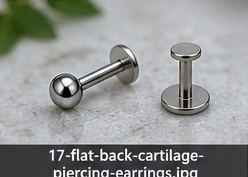
Bring any details you have about the initial jewellery, including its material, gauge and post length or ring diameter. Explain which activities bring the area into contact with clothing, hair, glasses or headphones. If you have a design in mind for later, show the piercer the exact product variant rather than a general image of the look. The piercer can check the channel and discuss the dimensions a replacement would need.
If a downsize is advised, let the professional perform it. They can choose a suitable piece and avoid unnecessary trauma during the change. A shorter post may reduce snagging when the swelling accommodation is no longer needed, but a post that compresses the tissue can create a different problem. Do not equate shorter with better. The aim is sufficient space for the actual channel without unnecessary projection.
Switching from a stud to a hoop
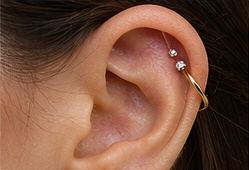
A ring follows a curved path and transfers motion differently from a straight post. The intended size depends on the angle of the channel and the distance from the channel to the relevant edge of the ear. A hoop that appears just large enough in a photograph may pull against your own ear. A healed conch may need substantially different clearance from a helix, even when both use the same gauge.
Ask the piercer to assess whether a ring is appropriate after healing. If you decide to purchase one, record the required internal diameter, gauge and closure type. Check the ring's entire construction, including where its hinge or seam rests. A suitable ring should not rely on sustained pressure to keep the desired aesthetic. There is no need to change a comfortable stud simply because a particular styling trend recommends a hoop.
What to do if the channel becomes sore again
If discomfort appears following an elective change, consider the new dimensions, shape and external contact. Do not repeatedly remove and replace pieces to try to identify the problem. Ask a qualified piercer to check the fit and obtain urgent medical advice if you suspect an infection, particularly with escalating pain, heat, swelling, pus or feeling unwell. Unless a clinician directs otherwise, leave the jewellery in when infection is suspected.
For future purchases, keep the details of jewellery that fits a fully healed channel. Record the selected variant rather than the retailer's generic product name. If an interchangeable end is part of your collection, note which post system it uses. This will help you avoid ordering a superficially similar item that cannot be assembled or fitted correctly. A successful first change can establish a useful reference for future styling without requiring frequent further changes.
Frequently asked questions
Is six months always enough?
No. Some cartilage piercings take longer; a professional assessment is more useful than a fixed date.
Can a piercer downsize before complete healing?
Yes, when the piercer determines it is appropriate. Have the change performed professionally.
Does a painless piercing prove it has healed?
No. The interior may still be healing even if the outside feels comfortable.
Professional references
Cartilage Piercing Jewellery Library
Complete guide
Main guides
- Best Cartilage Earrings
- Cartilage Piercing Jewellery Sizes: Gauge, Length and Diameter
- Best Materials for Cartilage Piercing Jewellery
- Cartilage Piercing Healing and Jewellery Aftercare
Supporting guides
- Best Helix Earrings and Jewellery
- Best Forward Helix Earrings
- Best Conch Earrings
- Best Tragus Earrings
- Best Daith Earrings
- Best Rook Piercing Jewellery
- Flat Piercing Jewellery: Styles and Placement
- Snug Piercing Jewellery Guide
- Best Titanium Cartilage Earrings
- Best Solid Gold Cartilage Earrings
- Cartilage Hoop vs Stud: Which Should You Choose?
- Best Flat Back Earrings
- Cartilage Piercing Bumps: Causes and Jewellery Problems