Cartilage Piercing Jewellery: The Complete Guide
Choose jewellery according to the piercing channel and its healing stage. A fitted flat-back stud, ring or curved barbell may suit different locations; a qualified piercer should select initial jewellery. For healed piercings, confirm gauge, wearable length or inner diameter, and material documentation before buying.
Start with anatomy, not the catalogue
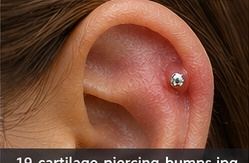
The word cartilage covers several distinct areas of the ear rather than one interchangeable hole. The helix follows the outer rim, the forward helix lies near its upper front, the flat occupies the upper area between the folds, and the conch sits in the bowl. The tragus is the small projection near the ear canal. The rook, daith and snug occupy different folds and have substantially different space constraints. An industrial connects two channels, making alignment a separate consideration. Each placement determines how the piece rests, how much it projects and what forces ordinary movement can transmit to it.
Look at the part of your ear the jewellery must pass through as well as the visible decoration. A piece marketed for multiple placements may still fit only some anatomies. Someone with a deep conch and a broad outer rim may need a different hoop from someone with a shallower ear. The same principle applies to curved barbells: a decorative end that fits a rook might be intrusive in a snug. A photograph of a model is useful for imagining the style, but it does not supply the dimensions of your own ear.
For a shortlist organised around the shapes suited to different placements, start with our cartilage earring buying guide.
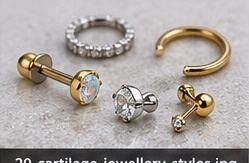
Build a wardrobe around fit
Begin with an everyday piece you already know is comfortable in a fully healed channel. Record its gauge and the wearable dimension. If you have a post, that means the usable shaft between the front and back; if you have a ring, record its internal diameter. Then consider a second style for the same placement. A small plain disc, a bezel-set gemstone and a modest decorative cluster can sometimes use the same compatible post, so you need not buy multiple complete assemblies. Check the manufacturer's threadless or threaded compatibility rather than assuming that every top fits every base.
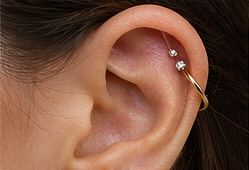
For a mixed-metal ear stack, establish one visual focal point before selecting smaller accents. A conch may carry the largest piece, with simple helix and flat jewellery around it. Alternatively, a decorative flat stud can anchor the upper ear while a plain conch stud keeps the centre quiet. The practical advantage of a deliberately small collection is that you can check fit and closure on each item, rather than accumulating pieces you cannot comfortably wear.
Before buying a second piece for the same channel, consult the cartilage size and measurement guide.
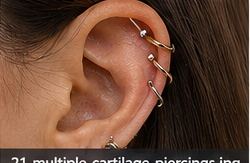
Compare materials and construction
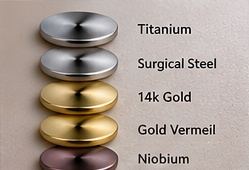
Colour does not identify a metal. Silver-coloured jewellery may be titanium, steel or white gold; a yellow finish might be solid gold, a coating or anodised titanium. Ask what material actually touches the channel and whether documentation supports the claimed grade. A smooth surface and a securely fitted end are as important as the appearance of a stone. Unexplained descriptions such as hypoallergenic or medical steel are not substitutes for specific evidence.
Think about the entire assembled piece, especially if a listing offers a gold top with a different post. The decorative front may be described as solid gold while the back is titanium. That can be a sensible configuration with appropriate documentation, but it is not a solid-gold assembly. Read the variant description, and check whether the price includes the post.
If you are choosing between finishes or checking documentation, see our comparison of cartilage jewellery materials.
Separate initial jewellery from later styling
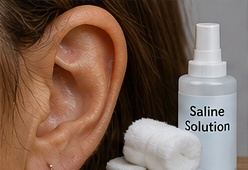
A newly pierced channel needs an appropriate sterile piece selected and fitted by a professional. Shopping for a future look is reasonable, but that is not a reason to exchange initial jewellery. The outside may look settled before the inside is ready. Some piercings need professional downsizing while still healing; a downsize is a fitting appointment, not an invitation to start changing jewellery at home.
After healing, consider whether your usual environment creates recurring pressure. Over-ear headphones, glasses, helmets and sleeping on the same side can all change the comfort of an otherwise attractive design. If a location repeatedly becomes sore, resolve the cause instead of buying a succession of decorations. An unexplained change in pain, heat or discharge warrants appropriate professional assessment.
For the transition from initial jewellery to future styling, read the healing and aftercare guide. The broader ear jewellery guide also covers other ear placements.

Make the final buying decision
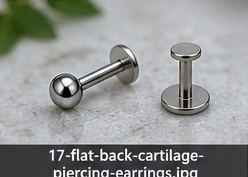
Check whether the listing identifies the actual gauge and dimension of the selected variant rather than only the dimensions of its decorative front. If a ring has stones around its outside, the stone setting contributes to outer size but not necessarily to the inner clearance. For a stud, a flat disc may look comfortable in a product image yet be unsuitable if the post is too short. Ask a piercer for measurements if you cannot establish them reliably.
Keep the packaging or note the specifications of successful pieces. A simple record such as healed left helix, 16G, measured wearable post length, compatible threadless top makes future shopping considerably easier. When replacing an item, compare those specifications before choosing a colour or motif. This is especially helpful if you have several cartilage piercings that look similar from the front but require different lengths.
We may earn a commission through affiliate links. These examples use OUFER's listed specifications, not hands-on tests. Confirm current price, availability, material evidence and fit before buying.
OUFER product options to compare

16G CZ Segment Titanium Cartilage Hoop – 8 mm
The feed identifies a 16G titanium hoop with CZ decoration and an 8 mm variant. Ask for the titanium grade and confirm internal diameter and healed-placement clearance.
Check price at Oufer
14K Gold CZ Flower Cartilage Earring
The merchant lists a 16G straight barbell, 8 mm length and 4 mm ball end, with a 14K solid-gold claim. Check the exact alloy and backing clearance.
Check price at Oufer
14K Gold Waterdrop CZ Rook Earring
OUFER lists a 16G rook design with clear waterdrop accents and a 14K gold claim. Confirm the curve, wearable length and clearance with your piercer.
Check price at Oufer
14K Gold Disc Threadless Cartilage Nose Stud – Top only / 1.5 mm
This exact variant is a 1.5 mm decorative top only, not a complete stud. Confirm compatible threadless post, gauge, length and material separately.
Check price at OuferFrequently asked questions
Can I wear one cartilage stud everywhere?
No. Similar looking piercings can have different channel dimensions and surrounding space. Confirm the type and fit for each location.
Does a matching ear stack require matching gauges?
No. The visual design can match while the shafts and wearable dimensions differ.
Professional references
Cartilage Piercing Jewellery Library
Complete guide
Main guides
- Best Cartilage Earrings
- Cartilage Piercing Jewellery Sizes: Gauge, Length and Diameter
- Best Materials for Cartilage Piercing Jewellery
- Cartilage Piercing Healing and Jewellery Aftercare
Supporting guides
- Best Helix Earrings and Jewellery
- Best Forward Helix Earrings
- Best Conch Earrings
- Best Tragus Earrings
- Best Daith Earrings
- Best Rook Piercing Jewellery
- Flat Piercing Jewellery: Styles and Placement
- Snug Piercing Jewellery Guide
- Best Titanium Cartilage Earrings
- Best Solid Gold Cartilage Earrings
- Cartilage Hoop vs Stud: Which Should You Choose?
- Best Flat Back Earrings
- When Can You Change Cartilage Piercing Jewellery?
- Cartilage Piercing Bumps: Causes and Jewellery Problems