What to know before choosing
Straight barbells and rings have different wearable geometries. A barbell has a straight shaft; a ring has a curved profile, although some clicker designs incorporate a straight segment. A professional should determine whether either design and its size suit your actual placement.
Compare the wearable shape rather than the label
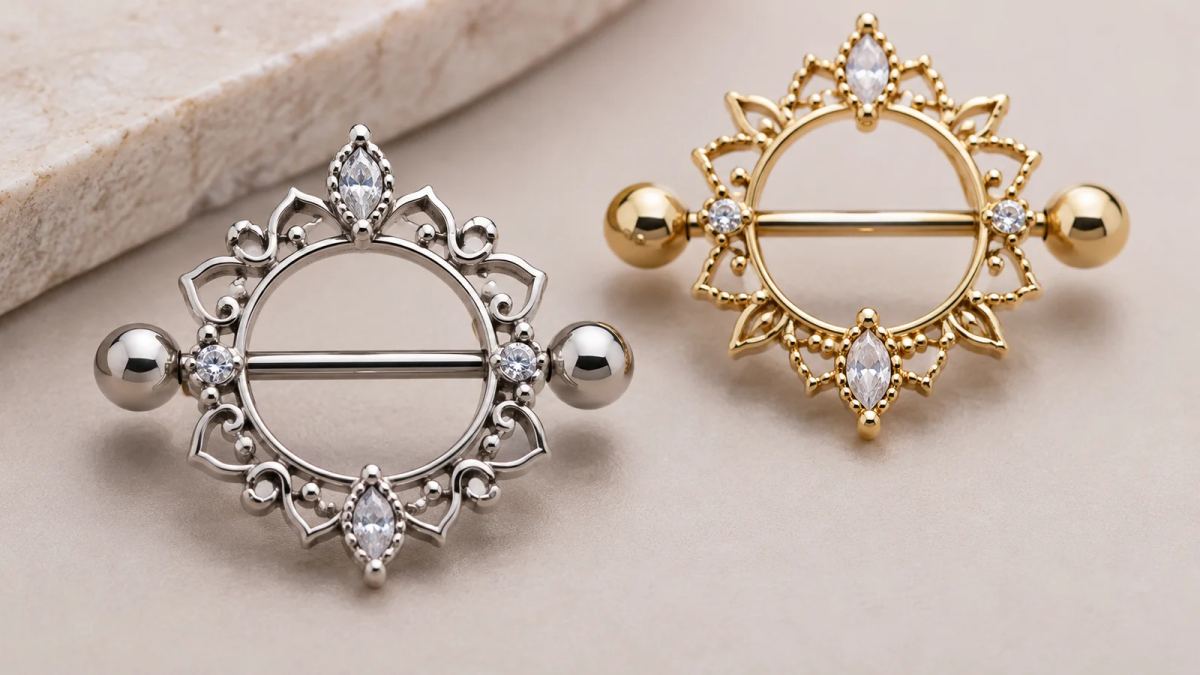
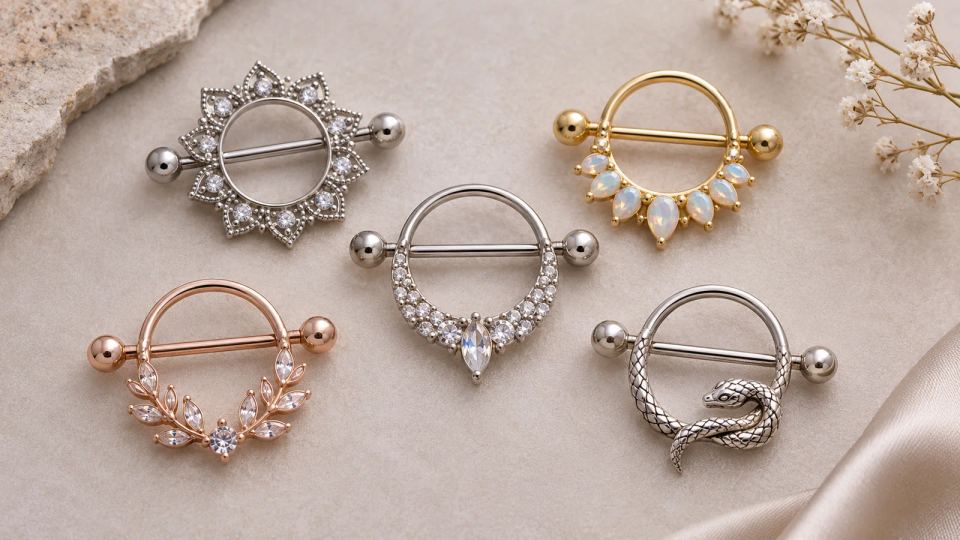
Product categories frequently use the term nipple ring for both straight bars and circular pieces. The name is therefore not a dependable way to distinguish their construction. A straight bar follows a straight path through the established piercing, whereas a curved design may change the way the jewellery interacts with the channel. Some decorative pieces combine a bar with an outer circle. Before deciding whether a ring is an alternative to a barbell, identify the part that enters the channel, its dimensions and its fastening. Front-facing photographs alone can obscure these details. Our guide to nipple jewellery types and styles illustrates the different structural categories in more detail.
What a straight bar can offer
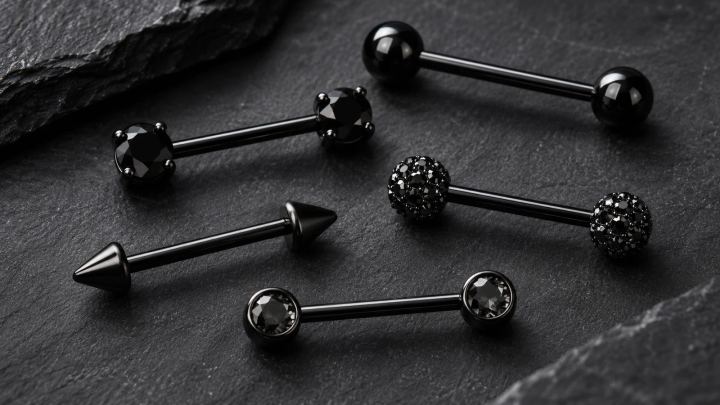
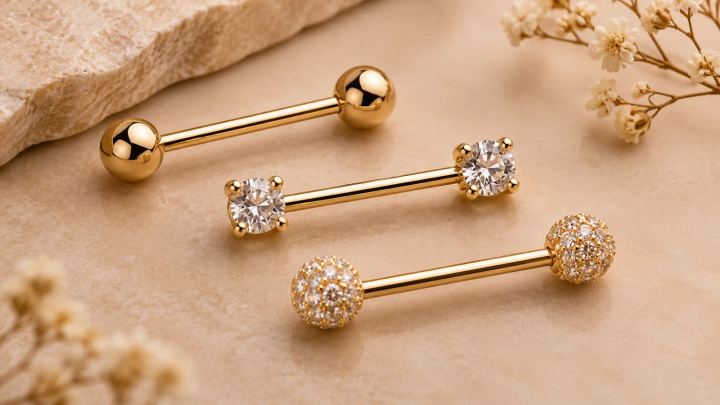
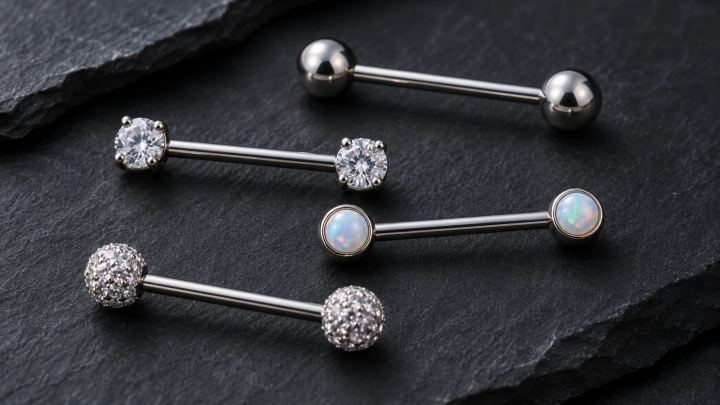
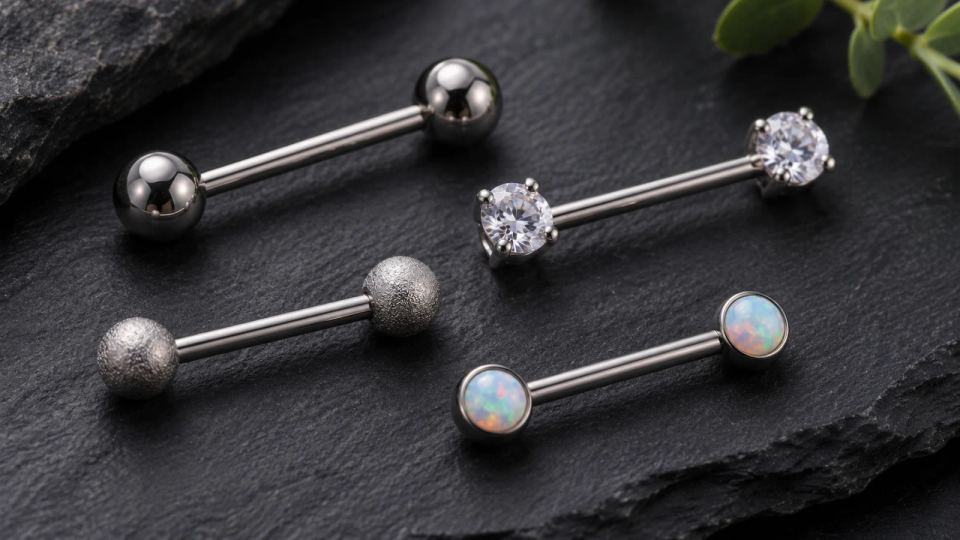
A plain barbell makes a useful reference point because its wearable portion and two attachments can be considered separately. The length between the ends can be checked against a professional fitting record. Different decorative ends change the profile without necessarily changing the underlying shape. However, the fact that a bar is straight does not guarantee that it is comfortable: a bar that is too short can produce pressure and one that is too long may catch. The size of its end components and the finish of the wearable surface also need to be appropriate.
What changes when considering a ring
A circular ring extends into the area around the placement. Its inner diameter and wire thickness are both important, and the curvature can have implications for the established channel. A ring may look compact in a catalogue yet occupy a considerable area when fitted. Do not select its inner diameter by treating the length of an existing straight bar as an equivalent measurement. Have a piercer assess whether the placement is suitable for the ring geometry, especially if the previous jewellery was fitted as a straight bar. Ring-style jewellery should be considered on its own merits.
Closure design and movement
Straight bars often have threaded or threadless ends, while rings can use captive beads, hinges or other closure designs. Inspect where the closure sits and whether seams can contact the channel. A hinge can make a design convenient to operate but does not prove that the ring fits. Likewise, a straightforward ball-ended bar is not necessarily secure if its attachments are damaged or incompatible. Ask about the exact product's closure and the manufacturer's guidance. If you have difficulty operating an existing assembly, arrange assistance instead of forcing the mechanism or repeatedly manipulating the placement.
A practical comparison for healed placements
Consider what the piece needs to do during your daily routine. A ring can provide a different outline, while a barbell may have fewer components projecting around the placement. A broad ring or a shield can interact differently with clothing, and certain barbell ends can also catch. The details of the particular design matter more than a general rule about which category is more comfortable. Keep the appearance, construction and fit as separate columns in your comparison. If you have an older piercing that becomes uncomfortable with a new geometry, seek assessment rather than assuming it will adapt.
When a change is not the next step
During healing, the initial jewellery and any professional downsize should be guided by the piercer. Moving from one geometry to another merely because a different style is available can introduce unnecessary difficulties. If an existing bar or ring feels tight, causes pressure or becomes increasingly uncomfortable, discuss the issue with a professional before choosing a replacement. Suspected infection needs medical attention. Once the piercing is fully healed and a new geometry has been assessed, compare real catalogue models using the confirmed dimensions rather than choosing an alternative on the basis of an attractive product image.
At a glance
| Feature | Straight bar | Ring |
|---|---|---|
| Wearable geometry | Straight | Curved or segment-based |
| Typical size descriptor | Wearable length | Inside diameter |
| Closure examples | Threaded or threadless ends | Hinge or other ring closure |
We may earn a commission through affiliate links. These examples are based on listed specifications, not hands-on testing. Confirm material documentation, fit and current availability with the seller and your piercer.
OUFER catalogue examples to compare

2Pcs Internally Threaded Titanium Nipple Barbell Pair - Opal
Merchant-listed titanium pair with internally threaded construction and opal accents; the product handle specifies 14G and 14 mm. Verify material documentation and usable length.
Check price at Oufer
Titanium Clicker Nipple Shield Pair
Listed as a titanium hinged shield pair. The product handle indicates 14G and 9/16 inch; confirm which dimension that describes.
Check price at Oufer
2PCS Half-Round Titanium Nipple Clicker
Merchant-listed half-round titanium clicker. Confirm the wearable geometry, dimensions and material specification.
Check price at OuferFrequently asked questions
Can a ring and a barbell share the same gauge?
Yes, but gauge is thickness only. It does not establish suitable geometry or length.
Are clickers the same as captive bead rings?
No. Their closures differ and may have different wearable segments.
Which is better for initial jewellery?
The qualified piercer determines an appropriate shape, material and fit for the placement.
Sources and further guidance
Nipple Piercing Jewellery Library
Complete guide
Main guides
- Best Nipple Piercing Jewellery
- Nipple Piercing Jewellery Types and Styles
- Nipple Piercing Jewellery Materials: Titanium, Gold and Steel
- Nipple Piercing Jewellery Sizes and Fitting Guide
Supporting guides
- Best Titanium Nipple Piercing Jewellery
- Best Gold Nipple Piercing Jewellery
- Best Black Nipple Piercing Jewellery
- Best Nipple Piercing Jewellery for Sensitive Skin
- Nipple Barbells: Styles, Materials and Fit
- Nipple Shields: A Complete Buying Guide
- Decorative and Dangle Nipple Piercing Jewellery
- Nipple Piercing Retainers: Types and Uses
- Internally vs Externally Threaded Nipple Jewellery
- What Gauge Is a Nipple Piercing?
- How to Measure Nipple Piercing Jewellery
- When Can You Change Nipple Piercing Jewellery?
- How to Clean Nipple Piercing Jewellery