What to know before choosing
For gold nipple jewellery, distinguish documented solid gold from gold-coloured titanium, plating and other finishes. Fourteen-karat solid gold is a common commercial choice, but alloy composition, construction and professional fit remain more important than colour or price.
Read the karat and construction together
Karat describes the proportion of gold in an alloy; it does not identify all the remaining elements. Fourteen-karat gold contains roughly 58.3 percent gold by the traditional calculation. A product listing should distinguish solid gold from gold-plated or gold-filled construction and identify the material of the wearable component. A gold-coloured ball on a different metal bar may be sold under the same general style category as a solid-gold piece. Treat each component and selected variant individually. A buyer should not rely on a luxury photograph to settle questions about metal composition or suitability. Our materials comparison for nipple jewellery also explains documented titanium and steel alternatives.
Yellow gold, white gold and rose tones
Yellow gold is often chosen for its familiar warm colour. Rose tones may be associated with copper-containing alloys, while white gold can use different alloying elements and may have a surface treatment. The precise composition varies, so colour is not a reliable guide to nickel content or other sensitivities. Ask the retailer about the specific alloy and any coating or plating. A wearer with suspected metal sensitivity should seek appropriate advice rather than assuming that a change from white to yellow gold is sufficient. The material of the shaft is especially important when considering a body-jewellery purchase.
Plain balls versus decorative ends
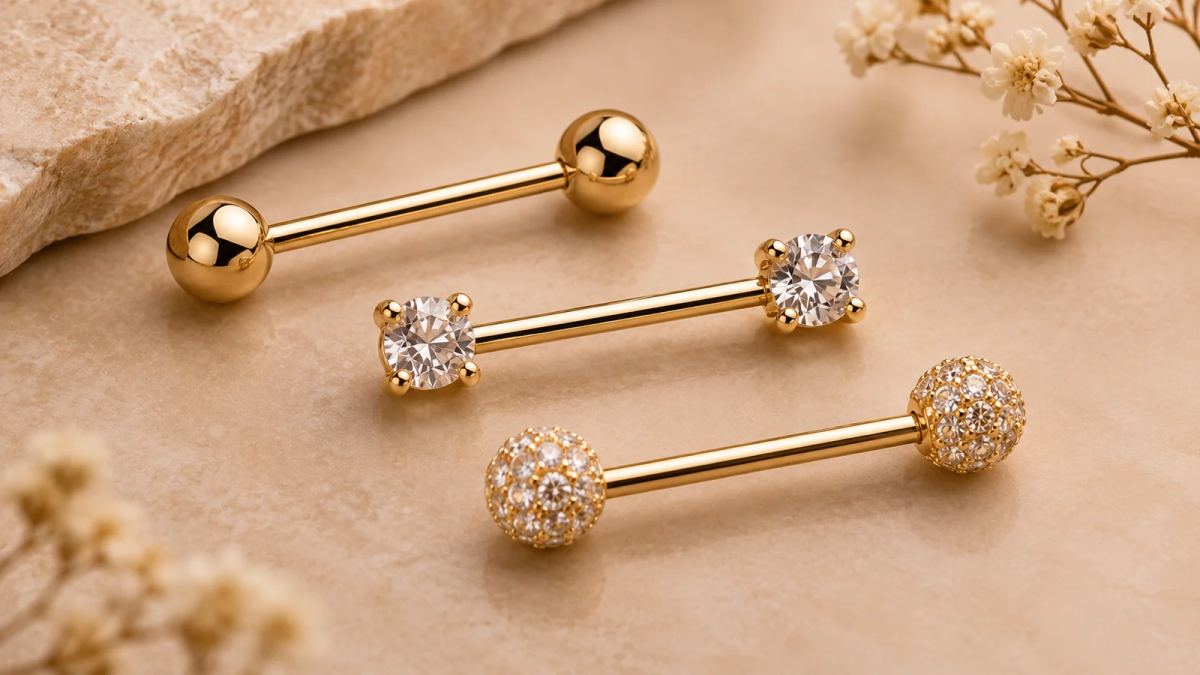
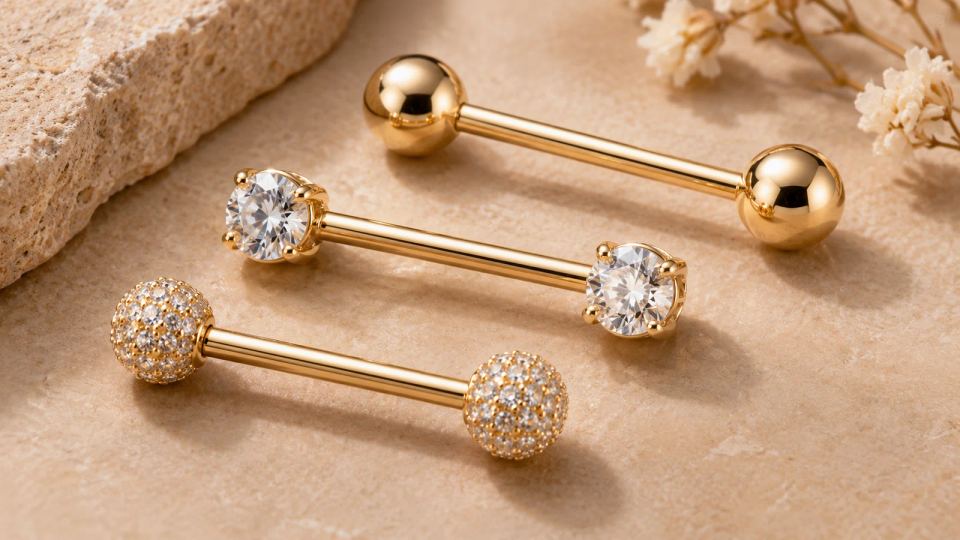
A plain gold barbell has relatively few decorative features, making it easier to compare attachment size and wearable length. Crystal-set and floral ends can provide a different appearance, but their settings can be wider and more projecting. Look at side-profile photographs and the dimensions of the actual ends. If a ring or shield is described as solid gold, determine which parts of the construction are included in that claim. A design may be expensive and visually refined without suiting your placement or daily routine. Only consider elaborate additions after healing has been professionally assessed.
Check the real size before comparing prices
Gold jewellery often has a substantial difference in price between models, and sometimes between size variants of one model. Avoid selecting a smaller variant because it is cheaper or in stock. Compare the actual wearable span rather than the overall dimensions including the attachments. When a seller offers 12, 14 and 16 mm lengths, these are distinct sizes, not interchangeable descriptions of one piece. Two placements can also need different lengths. Record your professionally measured requirements before opening product pages, and treat any unavailable matching size as a reason to consider a different product rather than compromise fit.
Evaluate replacement parts and closure
Gold jewellery represents an investment, so maintenance and replacement availability matter. Ask whether the attachments are sold separately and whether the bar uses an internally threaded or threadless system. Do not assume a gold attachment from one maker is compatible with a shaft of the same gauge from another. A decorative end with a particular orientation may also have a matching left or right component. Keep the product name, variant and purchase record. A damaged or missing attachment should be addressed professionally rather than improvised with unrelated jewellery parts.
Compare solid gold with a gold-coloured alternative
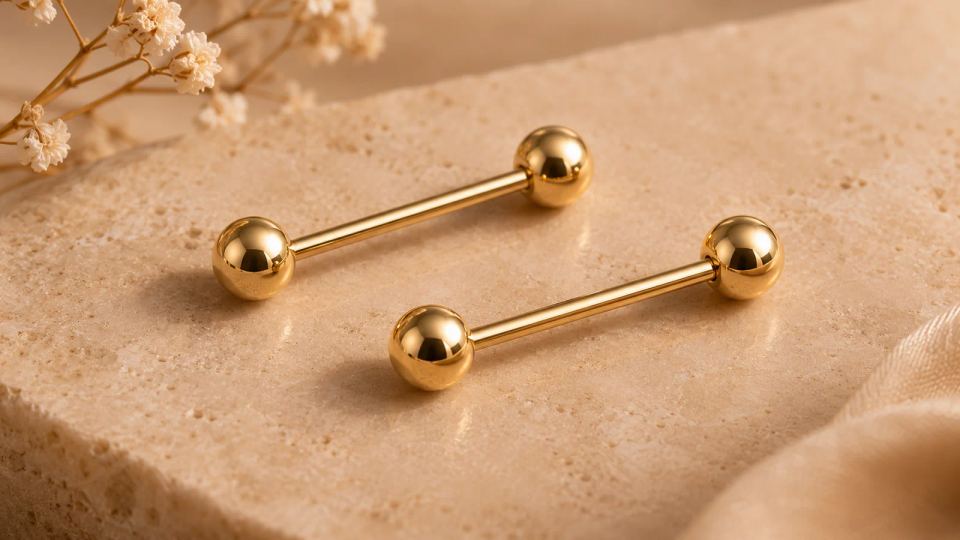
A wearer who mainly wants a warm metallic colour may find that a documented gold-toned titanium piece meets the visual preference without being solid gold. The comparison should focus on the underlying material, finish, manufacturing quality and intended use, not simply on which looks most luxurious. Conversely, someone specifically seeking solid gold should insist on an explicit description of the actual alloy. The merchant examples below are chosen because their listings identify gold construction or a relevant contrasting finish. They are not independent assay results, and none overrides a piercer's assessment of fit.
We may earn a commission through affiliate links. These examples are based on listed specifications, not hands-on testing. Confirm material documentation, fit and current availability with the seller and your piercer.
OUFER catalogue examples to compare

OUFER 14K White Gold Ball Nipple Ring
Merchant describes solid white gold and a plain ball design. Ask for the alloy composition and fitting dimensions.
Check price at Oufer
OUFER 14K Gold Ball Nipple Ring - 14mm
Listed solid gold ball design, 14 mm variant. Verify the gauge and wearable length against your fitting record.
Check price at Oufer
OUFER 14K Gold CZ Ball Nipple Ring - 14mm
Merchant-listed 14K gold with cubic zirconia, 14 mm variant. Check the full dimensions and alloy construction.
Check price at Oufer
OUFER 14K Gold Heart CZ Nipple Ring
Merchant describes a threadless solid 14K gold pair with heart-shaped cubic zirconia. Confirm compatible fitting and attachment details.
Check price at OuferFrequently asked questions
Is 14K gold automatically suitable for a new piercing?
No. The specific alloy, lack of unsuitable constituents, finish and professional fitting need to be established.
Does a gold-coloured titanium bar contain gold?
Not necessarily. Anodising can produce a gold tone without using gold.
Can I buy a replacement end separately?
Some makers sell them; verify the exact fastening and compatible model before ordering.
Sources and further guidance
Nipple Piercing Jewellery Library
Complete guide
Main guides
- Best Nipple Piercing Jewellery
- Nipple Piercing Jewellery Types and Styles
- Nipple Piercing Jewellery Materials: Titanium, Gold and Steel
- Nipple Piercing Jewellery Sizes and Fitting Guide
Supporting guides
- Best Titanium Nipple Piercing Jewellery
- Best Black Nipple Piercing Jewellery
- Best Nipple Piercing Jewellery for Sensitive Skin
- Nipple Barbells: Styles, Materials and Fit
- Nipple Shields: A Complete Buying Guide
- Nipple Rings vs Barbells: Which Is Better?
- Decorative and Dangle Nipple Piercing Jewellery
- Nipple Piercing Retainers: Types and Uses
- Internally vs Externally Threaded Nipple Jewellery
- What Gauge Is a Nipple Piercing?
- How to Measure Nipple Piercing Jewellery
- When Can You Change Nipple Piercing Jewellery?
- How to Clean Nipple Piercing Jewellery