What to know before choosing
Gauge describes the thickness of the wearable shaft; barbell length is the distance between its attachments, while ring diameter usually refers to the inside opening. Record all applicable measurements from a qualified piercer rather than selecting a universal size.
Gauge is not the overall length
Jewellery gauge is a thickness designation, not a measurement of how far apart the two ends of a barbell sit. A 14G shaft is approximately 1.6 mm thick, whereas 16G is approximately 1.2 mm. The higher gauge number in this example indicates the thinner shaft. Those values do not tell you whether either is appropriate for your specific placement. A catalogue that advertises a 14G pair may offer multiple wearable lengths at that same thickness. Confirm the currently fitted gauge professionally before considering another piece, especially if you do not have your original fitting record. The complete nipple jewellery guide covers how these measurements fit into the wider selection process. For a focused explanation of thickness conversions, see what gauge a nipple piercing uses.
Wearable span and total dimensions
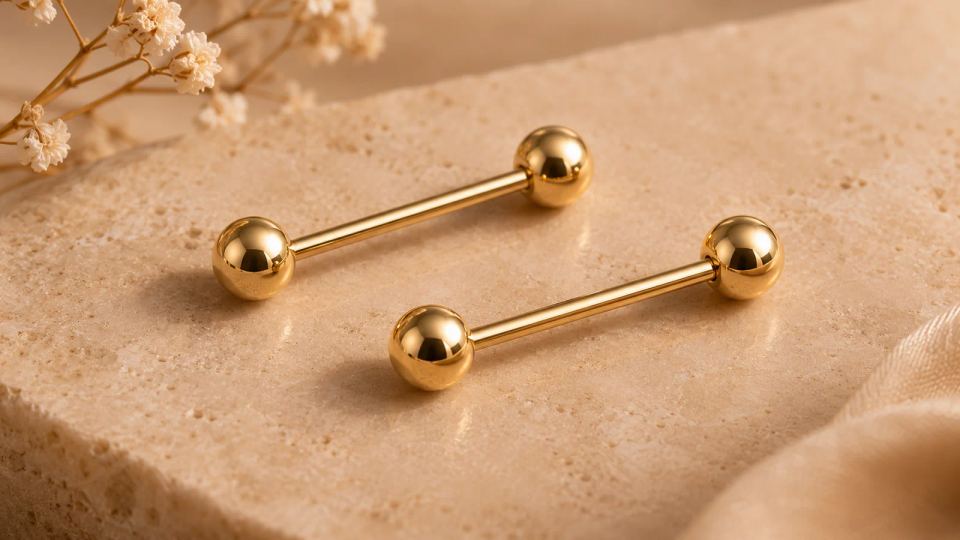
For a straight barbell, the wearable length generally excludes the decorative ends and is measured along the exposed shaft between them. A seller may separately provide the total length including attachments. Confusing these dimensions can lead to selecting a bar that is too short or too long. For an ornate shield, the central bar's usable span and the frame dimensions are different pieces of information. Check both. If the retailer provides only a photograph next to a ruler, request the defined wearable measurement instead of relying on perspective and apparent scale. Our guide to measuring nipple piercing jewellery explains which dimensions belong to each shape.
Ring diameter requires its own assessment
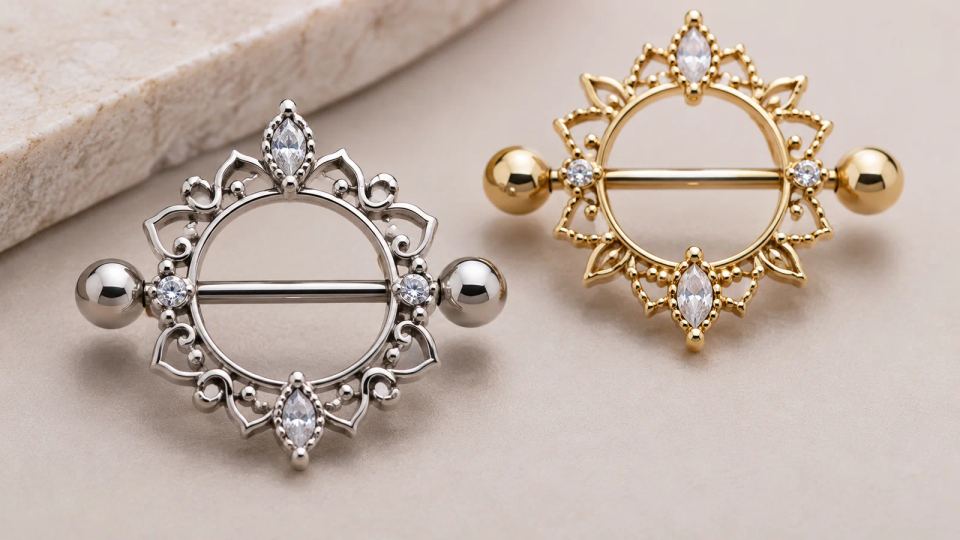
The inside diameter describes the open space within a ring. It is not necessarily equal to the wearable length of the straight bar it might replace. A curved piece follows a different path through and around the placement, and a hinged design can have a separate straight segment. A professional can determine whether a change of geometry is appropriate and what size is needed. The outer diameter can be useful for anticipating how much space jewellery occupies under clothes, but it cannot replace the inner diameter or other relevant measurements in a fitting decision.
The role of swelling and later fitting
Initial jewellery may be selected with space for swelling. As the healing process progresses, a professional may assess whether a different length is needed. The appropriate timing and fit vary; do not treat a shorter measurement from an online guide as a universal downsize. Excessively long jewellery can catch or move unnecessarily, while insufficient space can cause pressure. A professional should inspect persistent tightness, embedding or other changes rather than leaving you to solve them by ordering a succession of bars. If infection is suspected, obtain prompt medical advice rather than attempting a home jewellery change. Read when to change nipple piercing jewellery before planning a different length during or after healing.
Make a measurement record for both placements
Ask for the gauge, wearable length, fastening type and manufacturer of the current piece. Where appropriate, record the ball or attachment diameter and any other part of the assembly that affects fit. If there are two piercings, record the left and right measurements individually. Matching sets are often sold as identical pairs, but the tissue and channel geometry do not necessarily match. Knowing both sizes makes it easier to decide whether to purchase one pair, two individual pieces or a different design. Keep the information with the date of the most recent professional fitting.
Read size variants and units carefully
Retailers sometimes express dimensions in millimetres and sometimes use fractions of an inch. A nominal half-inch is 12.7 mm, which is not identical to 12 mm. A 9/16-inch dimension is approximately 14.3 mm, but manufacturers may round or label nominal sizes differently. Use the actual wearable measurement stated for the selected variant rather than rounding casually to the next available item. Also check whether the advertised dimension is the ring's inner diameter, the bar length or the overall width. When the diagram conflicts with the listing, obtain clarification before purchase. The nipple jewellery cleaning and aftercare guide explains why fitting and gentle care are separate from routine product maintenance.
At a glance
| Dimension | Meaning |
|---|---|
| Gauge | Shaft thickness |
| Wearable length | Usable span between ends |
| Ring inside diameter | Size of internal opening |
| Frame width | Overall decorative footprint |
We may earn a commission through affiliate links. These examples are based on listed specifications, not hands-on testing. Confirm material documentation, fit and current availability with the seller and your piercer.
OUFER catalogue examples to compare

OUFER 14K Gold Ball Nipple Ring - 12mm
Listed solid gold ball design, 12 mm variant. Confirm the wearable dimension rather than choosing by price.
Check price at OuferOUFER 14K Gold Ball Nipple Ring - 14mm
Listed solid gold ball design, 14 mm variant. Verify the gauge and wearable length against your fitting record.
Check price at OuferOUFER 14K Gold Ball Nipple Ring - 16mm
Listed solid gold ball design, 16 mm variant. This is a different length option, not a universal fit.
Check price at OuferFrequently asked questions
Is 14G standard for everybody?
It is commonly encountered, but the correct gauge is determined by the particular piercing and professional assessment.
Does a 14 mm bar mean 14G?
No. One specifies length and the other specifies thickness.
Can I measure jewellery while it is healing?
Ask your piercer rather than manipulating or removing healing jewellery.
Sources and further guidance
Nipple Piercing Jewellery Library
Complete guide
Main guides
- Best Nipple Piercing Jewellery
- Nipple Piercing Jewellery Types and Styles
- Nipple Piercing Jewellery Materials: Titanium, Gold and Steel
Supporting guides
- Best Titanium Nipple Piercing Jewellery
- Best Gold Nipple Piercing Jewellery
- Best Black Nipple Piercing Jewellery
- Best Nipple Piercing Jewellery for Sensitive Skin
- Nipple Barbells: Styles, Materials and Fit
- Nipple Shields: A Complete Buying Guide
- Nipple Rings vs Barbells: Which Is Better?
- Decorative and Dangle Nipple Piercing Jewellery
- Nipple Piercing Retainers: Types and Uses
- Internally vs Externally Threaded Nipple Jewellery
- What Gauge Is a Nipple Piercing?
- How to Measure Nipple Piercing Jewellery
- When Can You Change Nipple Piercing Jewellery?
- How to Clean Nipple Piercing Jewellery