What to know before choosing
A nipple piercing retainer is a piece intended to keep an established channel occupied while reducing its visual prominence or accommodating a particular requirement. It must still be correctly fitted and appropriate for the situation. Do not substitute generic clear plastic or remove jewellery during healing without professional guidance.
A retainer solves a specific problem
People consider retainers for work requirements, privacy, procedures or situations in which they do not want prominent jewellery. These are different reasons, and the correct response is not necessarily the same for each. A clear-looking piece may still have a visible outline, and a low-profile metal piece may be suitable for one workplace but not another. First establish the actual restriction: visibility, metal content, projecting components or all jewellery. Speak to the person responsible for the requirement before spending money on a piece that may not be accepted. A retainer cannot guarantee that the piercing will be undetectable. The nipple jewellery buying guide covers the general documentation and fitting checks that still apply to retainers.
Healing status determines the options
A healing piercing is not ready for elective jewellery changes simply because the desired retainer looks small or discreet. Initial material, fit and surface quality are important to the healing process. If a situation requires a change, contact the professional who fitted the jewellery and explain the time constraints. They can assess the placement and advise whether any appropriate option exists. Do not assume that leaving the channel empty for a few hours is harmless; established piercings can also shrink or close. Where a workplace or procedure requires removal, discuss the possible consequences in advance.

Clear materials are not interchangeable
Transparency is an appearance, not an indication of material quality. Clear products may be made from different polymers or glass, and they differ in construction, finish and suitability. Certain documented glass materials are recognised in professional guidance, but a generic clear plastic label does not provide equivalent evidence. Ask the piercer which material and design they recommend for the particular placement. A seller should identify the exact substance rather than relying on words such as flexible or invisible. Do not improvise a retainer using craft materials, ordinary household plastic or unrelated jewellery parts.
Medical procedures have separate rules
For medical imaging or a procedure, the facility determines what jewellery is permitted. Some restrictions relate to the equipment, others to the site of treatment or local clinical policy. A product advertised as non-metallic or MRI-friendly is not a substitute for clearance from the responsible clinical team. Contact the facility well before the appointment, explain the piercing and ask whether a professionally fitted retainer would be permitted. If removal is required, discuss that with your piercer as well. Medical safety requirements take priority over keeping the piercing open, and the appropriate approach depends on the procedure.
Fit and attachment remain important
A retainer still has a wearable shaft or other structural element, and its gauge, length and attachments need to suit the channel. A discreet design with ends that are too small or an inappropriate span can create fitting problems. Ask for the actual measurements and construction before purchasing. Do not assume a retainer intended for another body location is suitable because it has the same advertised gauge. If a selected piece relies on a particular closure or attachment, check how the manufacturer describes it and whether the piercer can fit it appropriately.
What to do when the right product is unavailable
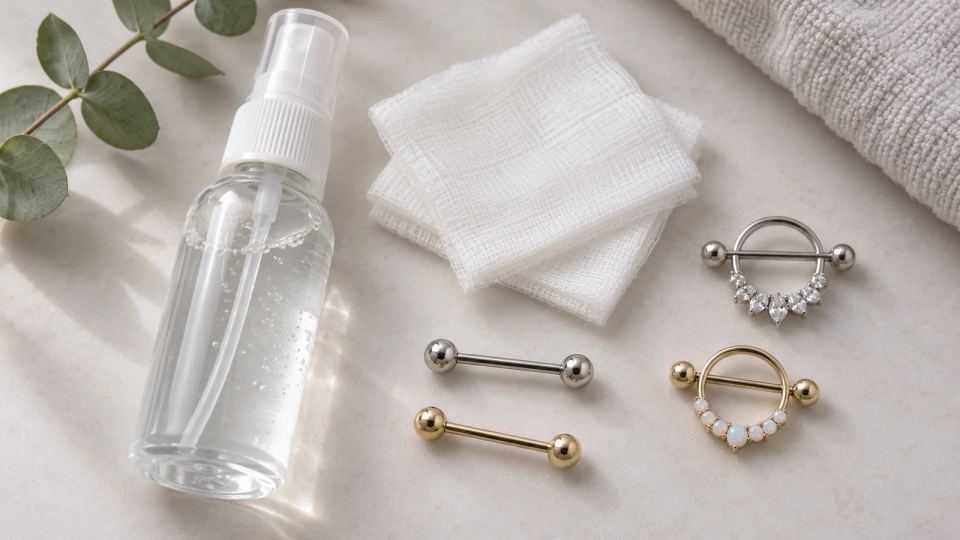
The current product examples for this publication do not include a verified dedicated nipple retainer that meets these selection criteria. Rather than substituting a generic transparent tongue or nose product, ask your piercer to source a suitable item from a professional supplier. Explain whether the requirement is temporary or ongoing, and keep a record of the measurements and material of any piece that is fitted. If a retainer cannot meet the restriction, make a plan that respects the workplace or medical requirement. Do not sacrifice correct material or fit just to find something quickly.
Frequently asked questions
Are retainers completely invisible?
No. Their visibility depends on the design, material and clothing.
Can I leave a healed piercing empty?
It can shrink or close unpredictably. Discuss options with a piercer before planned removal.
Is clear jewellery automatically acceptable for an MRI?
No. Obtain permission from the imaging team for the actual material and piece.
Sources and further guidance
Nipple Piercing Jewellery Library
Complete guide
Main guides
- Best Nipple Piercing Jewellery
- Nipple Piercing Jewellery Types and Styles
- Nipple Piercing Jewellery Materials: Titanium, Gold and Steel
- Nipple Piercing Jewellery Sizes and Fitting Guide
Supporting guides
- Best Titanium Nipple Piercing Jewellery
- Best Gold Nipple Piercing Jewellery
- Best Black Nipple Piercing Jewellery
- Best Nipple Piercing Jewellery for Sensitive Skin
- Nipple Barbells: Styles, Materials and Fit
- Nipple Shields: A Complete Buying Guide
- Nipple Rings vs Barbells: Which Is Better?
- Decorative and Dangle Nipple Piercing Jewellery
- Internally vs Externally Threaded Nipple Jewellery
- What Gauge Is a Nipple Piercing?
- How to Measure Nipple Piercing Jewellery
- When Can You Change Nipple Piercing Jewellery?
- How to Clean Nipple Piercing Jewellery