Gentle care for the piercing
For a healing nipple piercing, follow your qualified piercer's aftercare instructions. The Association of Professional Piercers recommends sterile saline wound wash, gentle care and avoiding unnecessary movement or harsh products. Established jewellery can be maintained as part of normal hygiene without forcing the piece to move.
Separate healing care from cleaning a spare piece
A barbell being worn in a healing channel is not the same as a spare item sitting in a jewellery box. The purpose of aftercare is to support the condition of the tissue, not to make the metal as shiny as possible. Removing or rotating jewellery for polishing can interfere with that goal. Follow the care advice given for your actual placement and arrange assistance if the jewellery needs attention. Cleaning a spare piece outside the body may require different instructions depending on its material, settings and construction. Do not apply a generic jewellery-cleaning method directly to a healing piercing.
Choose an appropriate saline product
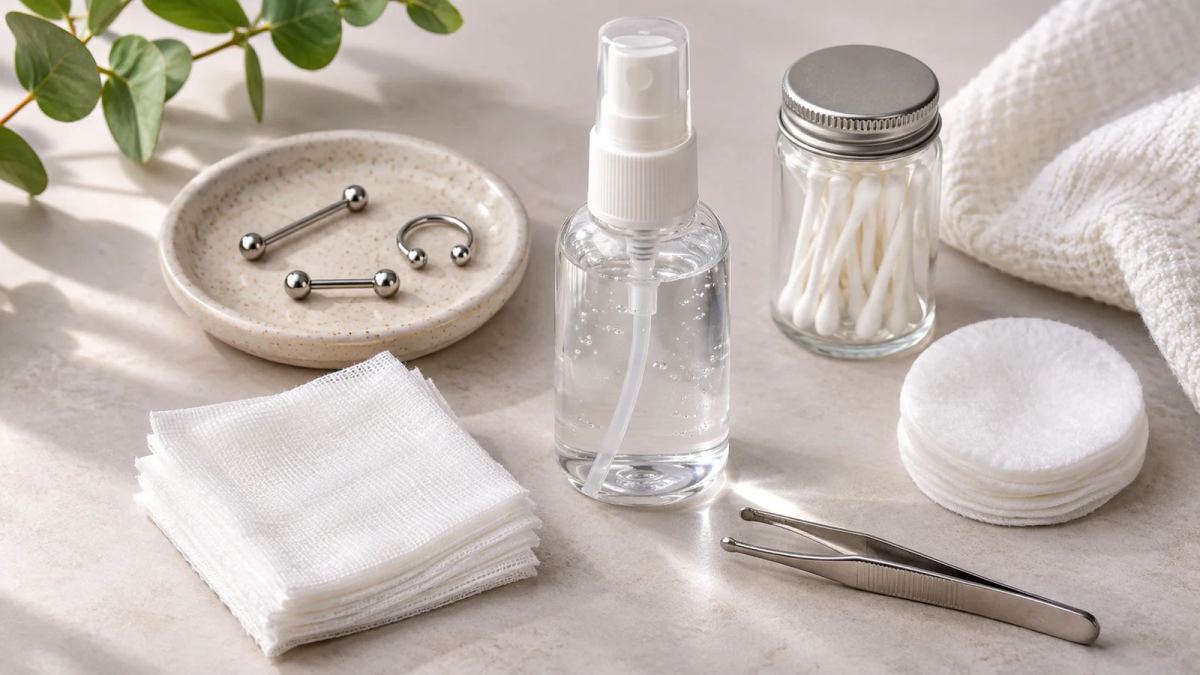
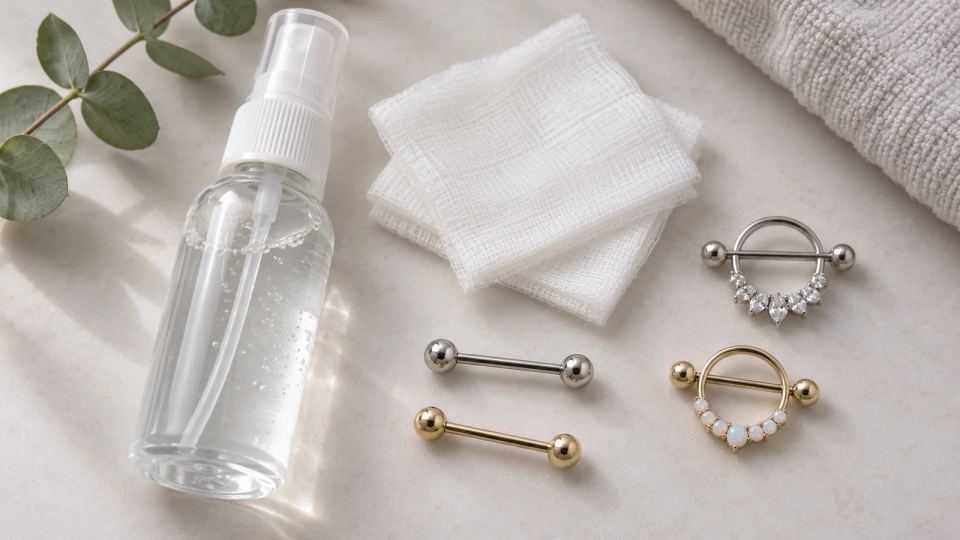
Professional piercing guidance recommends packaged sterile saline intended for wound care rather than an improvised salt mixture. Check the label for the appropriate simple formulation; products intended for contact lenses or other uses may contain ingredients that are not suitable for this purpose. Follow the instructions provided by your piercer and the product label. Do not treat a spray bottle in an editorial photograph as an identifiable medical product. Our images illustrate a care setting, not a recommended brand or an assessment of an actual wound. If you are unsure about a product, ask the professional who is advising you.
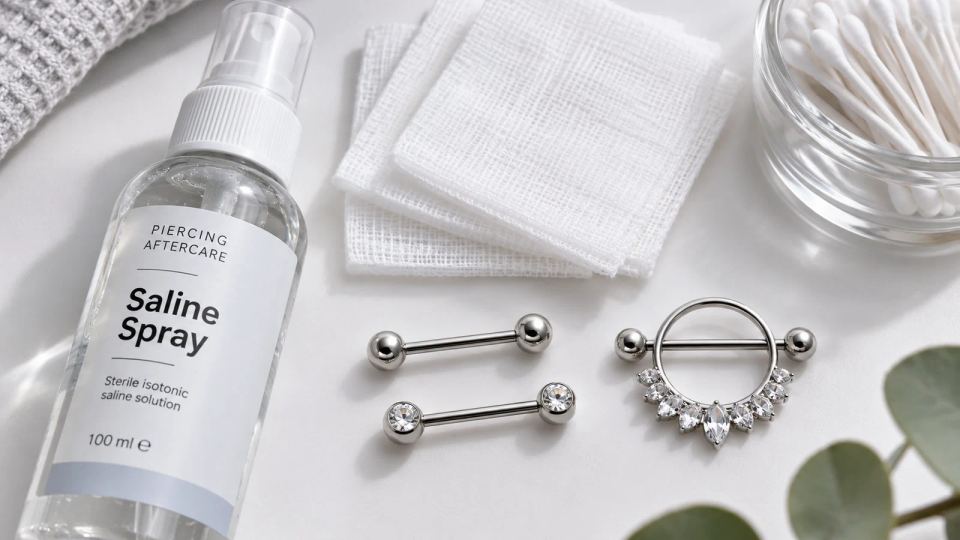
Gentle handling matters more than aggressive cleaning
Unnecessary movement, scrubbing and repeated handling can aggravate healing tissue. Wash your hands before necessary contact, follow professional rinsing instructions and use appropriate clean disposable material for gentle drying. Do not twist the jewellery to test whether it is clean. Avoid picking at deposits or forcing an attachment to move. A more intensive cleaning routine is not automatically more effective and may cause further irritation. If deposits cannot be managed comfortably using the recommended care routine, consult your piercer instead of attempting to scrape them away or changing the jewellery yourself.
Avoid household jewellery chemicals on a piercing
Products intended to polish ordinary metal jewellery are not designed for application to a healing wound. Alcohol, peroxide and harsh cleansers can also irritate tissue. Do not use abrasive materials on a body-jewellery surface or experiment with chemical mixtures to remove a stain. For jewellery outside the body, ask the manufacturer about material-specific care, particularly where plating, glued components or gemstones may be present. A piece with surface damage or an uncertain history should be inspected before use. Home cleaning does not necessarily make jewellery sterile or suitable for insertion into a healing channel.
Consider clothing and routine contact
Care also involves reducing avoidable friction and pressure. Choose clean clothing that accommodates the jewellery and avoid repeatedly catching it on towels or other textiles. If a particular design continually snags or causes pressure, a fitting assessment is more useful than increasing the cleaning frequency. Do not add a chain or other decoration during healing. For an established placement, incorporate sensible hygiene into your routine and seek advice if irritation returns. A record of when problems occur, including any recent product or jewellery change, may help your piercer distinguish mechanical concerns from other issues. Review the nipple jewellery fitting guide if pressure or movement is a recurring concern rather than a cleaning issue.
Know when to seek medical advice
A routine cleaning guide cannot diagnose complications. Increasing heat, pain, swelling, pus or feeling generally unwell can be reasons to obtain prompt medical attention. Follow NHS guidance for suspected infection and leave jewellery in place unless instructed otherwise by a clinician. Do not rely on an aftercare spray or a different barbell to treat a possible infection. For questions about the fit, condition or maintenance of the jewellery, consult a qualified piercer; for suspected infection or other medical symptoms, contact an appropriate healthcare professional. The two forms of advice serve different purposes.
Frequently asked questions
Should I rotate jewellery while cleaning?
Professional piercing guidance advises against unnecessary rotation during healing.
Can I use a jewellery polishing solution?
Do not apply ordinary jewellery-polishing chemicals to a healing piercing.
Does sterile saline cure an infection?
No. Suspected infection requires prompt medical assessment rather than self-treatment.
Sources and further guidance
Nipple Piercing Jewellery Library
Complete guide
Main guides
- Best Nipple Piercing Jewellery
- Nipple Piercing Jewellery Types and Styles
- Nipple Piercing Jewellery Materials: Titanium, Gold and Steel
- Nipple Piercing Jewellery Sizes and Fitting Guide
Supporting guides
- Best Titanium Nipple Piercing Jewellery
- Best Gold Nipple Piercing Jewellery
- Best Black Nipple Piercing Jewellery
- Best Nipple Piercing Jewellery for Sensitive Skin
- Nipple Barbells: Styles, Materials and Fit
- Nipple Shields: A Complete Buying Guide
- Nipple Rings vs Barbells: Which Is Better?
- Decorative and Dangle Nipple Piercing Jewellery
- Nipple Piercing Retainers: Types and Uses
- Internally vs Externally Threaded Nipple Jewellery
- What Gauge Is a Nipple Piercing?
- How to Measure Nipple Piercing Jewellery
- When Can You Change Nipple Piercing Jewellery?