What should you look for in titanium tongue jewellery?
Check documented titanium grade, the entire finished piece, shaft dimensions and end construction. Titanium can be a reasonable material to discuss with a professional, but it does not make an oral piercing safe for teeth or gums.
Distinguish titanium from a documented specification
The metal name on a product page is only the first step. The Association of Professional Piercers identifies particular titanium standards, including ASTM F136, for suitable initial jewellery. A listing may claim that standard without supplying traceable material documentation. Ask a reputable supplier or piercer for evidence appropriate to the piece. A description that says only titanium is less informative, particularly for someone who is trying to avoid a specific alloy component. Do not regard an inconsistent standard number as a minor detail that can be silently corrected. It is an unresolved specification, and the merchant should explain it before you make a material-sensitive purchase.
Know what the material claim covers
A barbell consists of more than a post. The attachments, threads, decorative settings and any joining materials may have different composition. A shaft described as titanium does not automatically make every component titanium. Synthetic opal is a decorative material, not proof of a particular grade of the underlying metal. Ask how the stone or design is retained and whether all exposed surfaces are smooth. The lower attachment is especially important in a tongue piercing because it moves within the mouth. A material certificate can answer a composition question but cannot determine whether a particular end shape fits your anatomy.
Weight, surface quality and colour
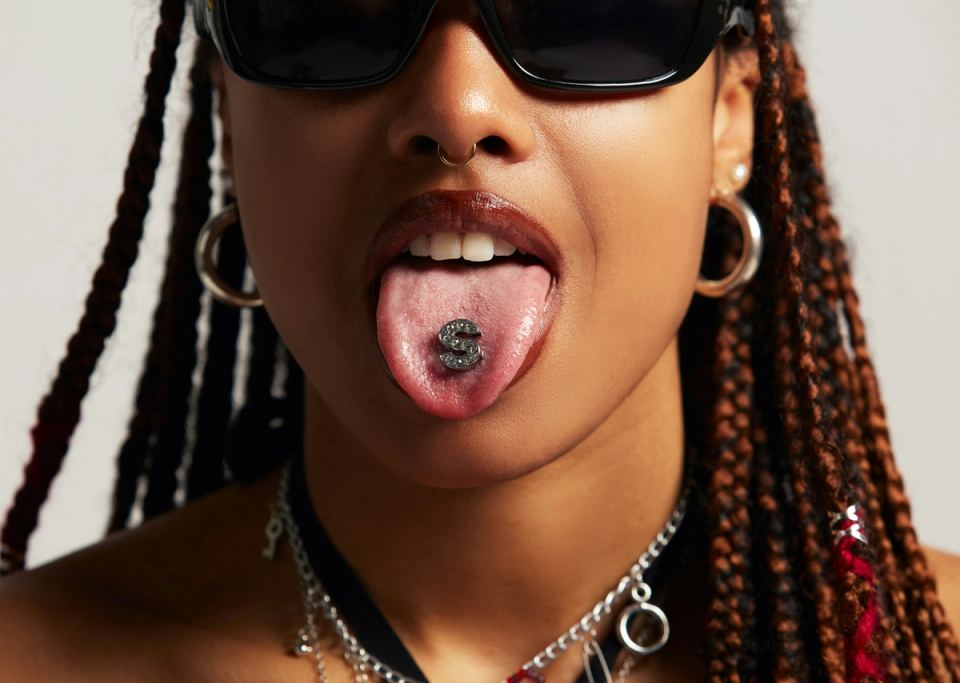
Titanium generally has lower density than stainless steel, but a large decorative titanium end can weigh more than a smaller steel one. Overall dimensions and construction therefore matter when comparing complete pieces. A polished silver appearance is not evidence that a metal is titanium, and gold or black finishes need their own documentation. Ask about any treatment and the actual material underneath it. For oral jewellery, a surface should not be selected simply because it looks striking; roughness, damaged coatings or protruding features deserve attention from a professional. Do not attempt to polish or refinish a piece yourself to make it suitable.
Return to the Tongue Piercing Jewellery: The Complete Guide for fit and dental considerations.
For yellow or white finishes, see Best Gold Tongue Piercing Jewellery to distinguish appearance from gold content.
For dark surfaces, read Best Black Tongue Piercing Jewellery before assuming a coating or base metal.
Compare the actual merchant examples
The white flat synthetic opal bar and internally threaded flat synthetic opal bar are both described by the retailer as ASTM F136 titanium. The heart-shaped titanium-labelled product has internal threading in its title but the supplied description does not establish a specific grade. That is a meaningful distinction, not a reason to invent a certificate. One other heart opal listing uses inconsistent standard wording; ask for clarification rather than treating it as equivalent. Check length and gauge for every selected variant, and compare the profile of both ends. The photographs alone cannot establish that the pieces suit your mouth.

Consider alternatives with a professional
If you are choosing titanium because of previous irritation, first establish whether the issue is material sensitivity, mechanical pressure or something else. A healthcare professional can assess suspected allergy or infection, and a qualified piercer can evaluate the jewellery and channel. Dentists can assess tooth and gum contact. Repeatedly switching between products without understanding the underlying issue is not a useful experiment. If keeping oral jewellery is causing problems, discuss whether it should be removed rather than searching indefinitely for a different metal. The ADA's advice against oral piercing is relevant even when the material has good documentation.
A sensible purchase record
Keep the product name, retailer's grade claim, documentation where available, shaft gauge, measured length, closure and end dimensions. This information helps the piercer compare the proposed replacement with your existing piece. Do not rely on a screenshot of a generic listing whose variant selection may have changed. If a replacement uses compatible parts from an established system, confirm that compatibility with the manufacturer instead of assuming it from the gauge. A titanium-labelled piece with incomplete information is not equivalent to a professionally selected bar whose composition and dimensions are known.
If irritation is the reason for shopping, see Best Tongue Jewellery for Sensitive Skin to distinguish material and clinical questions.
To compare specific alloy claims, consult Titanium vs Surgical Steel Tongue Barbells rather than generic metal descriptions.
Our titanium lip jewellery guide discusses material documentation for another oral placement, not interchangeable geometry.
We may earn a commission through affiliate links. These are catalogue examples, not hands-on tests or safety endorsements. Confirm current stock, price, materials and fitting with the merchant and professionals.
OUFER catalogue examples

OUFER Flat Synthetic Opal Titanium Tongue Barbell - White
Merchant claims ASTM F136 titanium and flat synthetic opal top. The feed link identifies 14G and 16mm; confirm actual dimensions and suitability.
Check price at Oufer
OUFER Synthetic Opal Internally Threaded Titanium Tongue Barbell
Listed as internally threaded ASTM F136 titanium with a flat synthetic opal top. No independent material certification or dental safety is established.
Check price at Oufer
Heart Internally Threaded Titanium Tongue Barbell
Titanium-labelled heart design with internal threading. Ask for documented grade, exact measurements and end profile.
Check price at OuferFrequently asked questions
Does the word titanium prove implant grade?
No. Ask for the specific documented grade and the components it covers.
Sources and professional guidance
- American Dental Association: oral piercing and jewellery
- Association of Professional Piercers: oral piercing risks
- Association of Professional Piercers: oral aftercare
- Association of Professional Piercers: fitting and downsizing FAQ
- Association of Professional Piercers: initial jewellery
- NHS: infected piercings
Tongue Jewellery Library
Complete guide
Main guides
- Best Tongue Piercing Jewellery
- Tongue Piercing Jewellery Size Guide
- Tongue Piercing Jewellery Types and Styles
Supporting guides
- Best Straight Barbells for Tongue Piercings
- Best Gold Tongue Piercing Jewellery
- Best Black Tongue Piercing Jewellery
- Best Tongue Jewellery for Sensitive Skin
- Best Minimalist Tongue Piercing Jewellery
- Best Decorative Tongue Piercing Jewellery
- Titanium vs Surgical Steel Tongue Barbells
- 12mm vs 14mm vs 16mm Tongue Barbells
- 12G vs 14G Tongue Piercing Jewellery
- Internally vs Externally Threaded Tongue Jewellery
- Tongue Piercing Jewellery and Tooth Damage
- Best Tongue Piercing Retainers
- When Can You Change Your Tongue Piercing Jewellery?
- When Should You Downsize Your Tongue Barbell?