
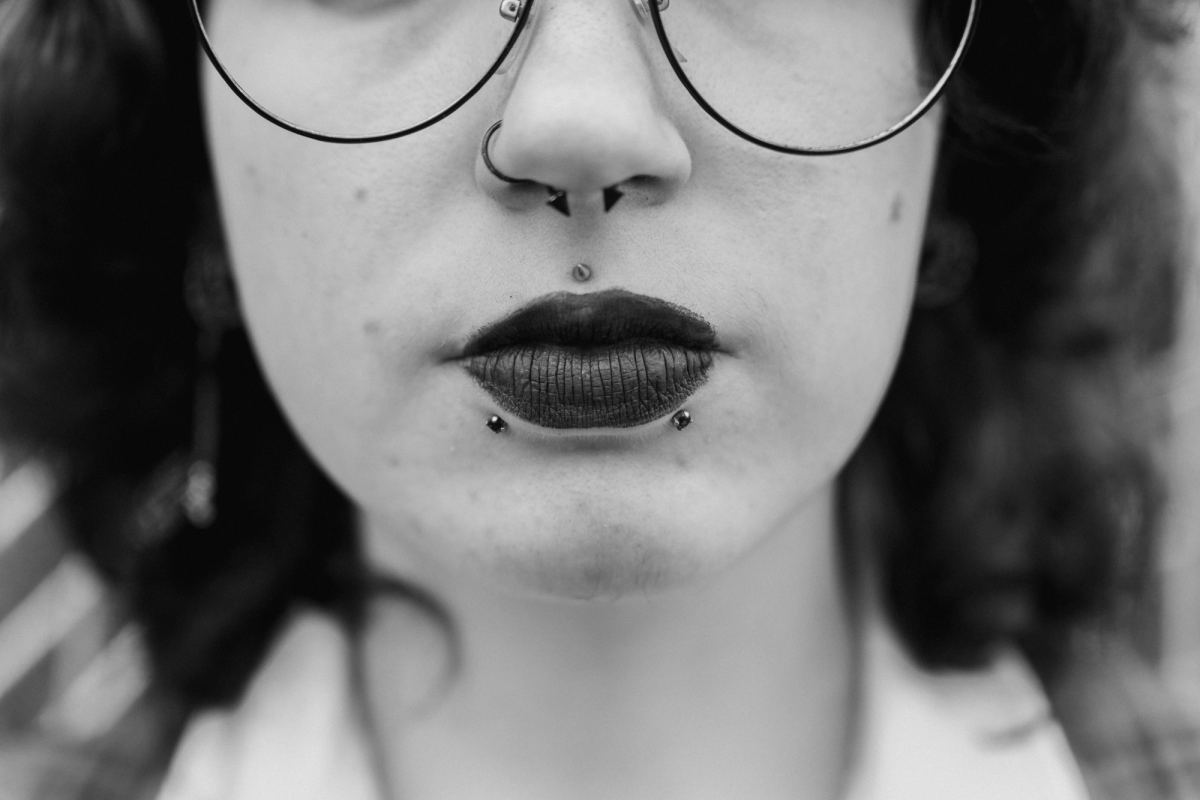
Lip jewellery · Complete guide
Lip Piercing Jewellery: The Complete Guide
Choose jewellery by placement, fit and material before style. Lip jewellery that touches teeth or gums carries dental risks even after healing.
Understand the placements
A central labret is placed below the lower lip and typically has an interior backing. Medusa is centred in the philtrum; Monroe is offset above the upper lip. Snake bites are paired lower-lip piercings. Vertical labret passes through the lower lip with both ends outside the mouth; Ashley has an exterior end and an interior backing. These are different channels, not interchangeable names for the same stud.
For a healed channel that can accommodate circular jewellery, the lip ring buying guide compares the main shapes. For straight-post constructions, consult the labret stud guide.
Choose the right shape
A flat-back post may be appropriate for a conventional labret, Medusa or Monroe after assessment. Circular jewellery can suit certain healed lower-lip channels, but the diameter needs to follow the tissue without tension. Vertical labrets commonly use a curved barbell. A straight flat-back stud is not an alternative merely because the shop labels both products labret.

Before ordering, read the lip jewellery size guide to separate post length from ring diameter; the titanium lip jewellery guide explains material documentation independently of geometry.
Material and finish
Ask for documented implant-grade titanium or an appropriate solid gold alloy. Check the wearable surface for smoothness and ensure the closure is compatible with the post. Colour is not evidence of composition. A decorative top and its post can be made from different materials.
For other facial placements, our nose piercing jewellery guide covers nostril and septum fitting decisions separately.
Fit and healing
Keep a record of the gauge, wearable length or inner diameter and closure system fitted by your piercer. Initial swelling may call for additional space, followed by professional downsizing. Do not select an arbitrary shorter post based on a photograph.
Dental considerations
Oral-facing backs and rings can contact teeth and gingiva during talking and chewing. Ask a dentist to assess contact and changes over time. Choosing titanium or a shorter post does not eliminate these risks.
| Measurement | What it describes |
|---|---|
| Gauge | Post or ring thickness |
| Wearable length | Space between stud ends |
| Inner diameter | Usable ring opening |
A placement-by-placement buying map
Begin with the exact name and location of your piercing, not the catalogue category. A shop may list the same ornament under nose, ear and lip jewellery because the decorative end looks similar or because several posts are available. That is a merchandising decision, not a fitting recommendation. Ask your piercer to write down the specific channel, direction and jewellery geometry. If you have not been pierced, discuss the likely jewellery with the studio before spending money on a piece you may never be able to wear.
A traditional central labret sits below the lower lip, with its backing inside the mouth. The visible end is usually a ball or decorative stud. A side labret follows the same general concept but sits closer to a corner. An apparently symmetrical face can have different tissue thickness and tooth alignment on each side, so a placement that works on the left may not be suitable on the right. With a paired piercing, keep a separate measurement record for each channel.
Upper-lip piercings have different visual constraints. A Medusa sits in the central philtrum, while a Monroe sits off centre above the lip. A piece that looks beautifully proportioned in a close-up can be too wide for a narrow philtrum or interfere with movement when smiling. Consider the visible ornament separately from the hidden backing; a photograph cannot show the latter's relationship to the teeth.
A vertical labret travels through the lower lip and has both ends externally visible. An Ashley piercing generally has one end on the lip itself and an internal backing. These are not cosmetic variations of one identical hole. Their geometry and oral-contact risks differ. Discuss them as separate procedures and avoid ordering based on the word labret alone.
How to compare the main jewellery constructions
Think about a piece of jewellery as a system with three jobs: occupy the channel without unnecessary pressure, retain its ends securely, and present a finished surface that suits its location. For a post, the wearable shaft and backing do the first job; the thread or pin does the second; the ball, gem or ornament does the third. Changing one part can affect the others.
A flat-back stud is compact, but the diameter of its disc matters. The disc is not supposed to be a universal protective shield. A wide disc can extend into an unsuitable area, while a small one may concentrate pressure. A professional needs to assess the fit in the mouth as well as the view from the front. A decorative top attached to an ear post is not automatically suitable simply because it has a flat back.
A ring has a different relationship to the tissue. Its inner opening determines how much room the lip has, and the curvature changes the direction of contact. The visible part of a circular barbell is broken by two ends; a segment or clicker provides a continuous outline with a closure. Consider the position and quality of any seam. A snug-looking ring on a model might be inappropriate on a thicker or differently angled lip.
For a vertical placement, the conversation is often about a curved barbell rather than a straight post or circular hoop. The curvature, wearable length and ends should be considered together. If the retailer cannot describe the construction clearly, postpone the order. The right outcome is a piece that matches your own specification, not a product that happens to appear under a popular search term.
The information to request from a retailer
A useful listing should identify the material of the post and each end, the dimensions of the exact variant, the closure mechanism and what is included in the package. Photographs alone cannot establish these facts. Read the selected variant rather than the headline: a product page might show a 6 mm default even though its photographs depict a longer model.
Ask whether the grade claim is supported by documentation. The Association of Professional Piercers publishes material and construction criteria for initial jewellery; a marketplace's description does not itself demonstrate compliance. In particular, a titanium-coloured finish is not a grade, and a gold-coloured coating is not solid gold. Avoid inferring the material of a hidden post from the appearance of an ornament.
Check what will happen if the size is wrong. Body jewellery often has restrictions on returns once packaging is opened. Establish the dimensions before ordering rather than buying three sizes with the intention of trying them all on. The cost of professional fitting should be considered part of the purchase, not an optional extra to avoid.
If you plan to purchase interchangeable ends, ask for the manufacturer's post and end compatibility information. A label such as 16G tells you the shaft thickness, not the thread pitch or pin geometry. Buy a compatible complete system when the connection is unknown. A spare decorative end is not a spare complete piece of jewellery.
Retail prices and availability can change between publication and a visit. The product cards in this guide are shopping examples, not laboratory tests, fit assessments or claims of current inventory. We use affiliate links where applicable. Compare the selected product with your specification even when the link leads to an attractive offer.
A practical decision sequence for a healed piercing
Imagine you have a lower-lip stud that has been professionally assessed as healed, and you want to exchange a simple ball for a ring. First ask whether your channel's angle and position can accommodate that ring. A ring is not merely a different decorative end; it creates a new contact geometry. If the placement cannot accommodate it, a different stud design may be a more realistic style change.
If a ring is appropriate, obtain its required inner diameter and gauge. Do not copy the diameter from another person's order. A ring that forces the lip into a different position is not a good fit, regardless of how popular that look is. Check the planned closure against the channel and discuss installation with your piercer.
For someone who prefers a flat-back stud, take the fitted post specification and decide whether to retain the current compatible system or replace it altogether. A small end may work better in a crowded arrangement than a large flower. Check the decoration from several angles because protrusion is not obvious in a front-facing product image.
Lastly, consider ordinary activities: talking, eating, wearing a scarf, contact with a musical instrument, sporting equipment or a uniform. The piece should be evaluated in the context in which it will actually be worn. Do not assume a comfortable appearance in a photograph is evidence of comfortable function.
A similar process works when styling paired lower-lip piercings. Write down both sets of dimensions, then choose the matching aesthetic. Ordering a visually identical pair first and making the tissue accommodate it afterwards reverses the sensible sequence.
Planning a first piercing rather than shopping for a replacement
A person considering a lip piercing has a different decision from someone choosing jewellery for a fully healed channel. A prospective wearer needs a consultation, an assessment of anatomy, an explanation of the procedure and risks, and a realistic plan for follow-up. Choosing a particular online product before that consultation may unnecessarily restrict what the studio can safely offer.
Ask the piercer what material and closure system they use and how they establish the initial length. Discuss what a follow-up appointment involves and how to recognise an unsuitable fit. A studio should be willing to explain the purpose of the initial space and the reason a later change may be appropriate. Do not use a friend's healing history as your own timetable.
If dental health is already a concern, discuss it with a dentist before proceeding. The American Dental Association advises against cosmetic oral and perioral piercing because of the associated risks. A qualified piercer can discuss risk-reduction measures, but no jewellery specification makes an oral-facing piercing risk-free. Choosing not to proceed is a valid outcome.
For an existing piercing, changing jewellery is not the appropriate response to every problem. Seek professional assessment of persistent irritation or unexpected changes. Treat severe or rapidly progressing symptoms as a health concern rather than a shopping problem. You should not need to order a decorative replacement to obtain help.
If all you want is the appearance for a photograph or a temporary outfit, consider a non-piercing accessory instead. This is not equivalent to a professionally fitted piercing and still requires sensible handling, particularly around the mouth. Avoid anything that is unstable or uncomfortable.
Build a personal jewellery record
A short record on your phone can prevent many ordering mistakes. Keep the date and type of piercing, the studio's contact information, the last professionally confirmed gauge, post length or ring diameter, end dimensions and manufacturer or closure system. For paired piercings, label the left and right separately.
Keep the exact variant number from an online order as well as its product title. Variants on the same listing can differ in length, finish and end size, so a title alone may be insufficient to reorder a known piece. Record whether the retailer supplied a complete item or just a replacement top. If a studio changes the fit, update the record rather than continuing to order the older size.
This guide is the starting point for our lip jewellery library. Use the dedicated size guide to understand measurements, the labret comparison to learn the closure options and the placement-specific articles to narrow your choice. Readers interested in other piercings can follow our nose and ear jewellery guides, but the dimensions should never be transferred directly between those areas.
A quick route through the library
Readers generally arrive here with one of several different questions. Someone planning a first lip piercing is looking for a studio, suitable initial jewellery and information about the risks. Someone who already has a healed piercing might be trying to buy a compatible new end, identify a replacement post or compare an entirely different jewellery shape. Those situations should lead to different articles.
If you are comparing placement names, start with the dedicated Medusa, Monroe, Ashley and vertical labret guides. For paired lower-lip styles, the snake bites and spider bites articles explain how the arrangement changes the decisions about clearance and individual fit. If you have an established placement and know its name, the best labret studs and lip rings guides focus on the available constructions and the questions to ask a merchant.
For an unfamiliar size label, use the size guide and the measurement article before looking at a product listing. If the uncertainty is whether a decorative end will work with a post you own, the internally threaded versus threadless comparison is a more direct starting point. Someone with an allergy or concern about composition should consult the material-specific guides and appropriate professionals rather than use a style guide to make a medical decision.
The fresh-piercing and jewellery-change articles do not present retail ornaments as a substitute for professional initial fittings or follow-up. If you prefer a temporary look without a permanent piercing, the fake lip rings guide considers a separate type of accessory. You do not need to make a permanent decision to explore a style.
The most useful route through the library is the one that answers the specific question you have today. You can bookmark the articles for your placement and return to the buying guides once your size and hardware specification have been confirmed. This is more efficient than reading every product recommendation before establishing what kind of piece you need.
Product options to consider
We may earn a commission from qualifying purchases through affiliate links. Product details come from the Oufer feed; we have not independently tested these items or confirmed current stock. These examples are not recommendations for initial jewellery.

CZ Internally Threaded Titanium Labret Stud – CZ 3mm
Small CZ decoration; ask your piercer to confirm post length and fit.
Check current price at Oufer
Synthetic Opal CZ Threadless Titanium Labret Stud – 8mm
Threadless decorative stud; 8 mm is a listed variant, not a universal fit.
Check current price at Oufer
6PCS Ball Lip Ring Set – 12mm
Merchant describes stainless steel; confirm alloy and inner diameter. Not a default choice for nickel-sensitive wearers.
Check current price at OuferFrequently asked questions
Can I order jewellery using only the gauge?
No. Verify shape, length or inner diameter, end design and closure with your piercer.
Is this suitable for a new piercing?
Retail examples are for consideration only after healing and a professional fit check. Initial jewellery is selected and fitted by your piercer.
What if jewellery touches my teeth or gums?
Arrange dental and piercing assessments. Even well-fitted oral jewellery carries risk; the American Dental Association advises against cosmetic oral and perioral piercing.