
Lip jewellery · Expert-informed guide
Best Vertical Labret Jewellery
Vertical labrets commonly require a curved barbell fitted to the channel. Do not substitute straight flat-back studs from conventional labret collections.
Different channel geometry
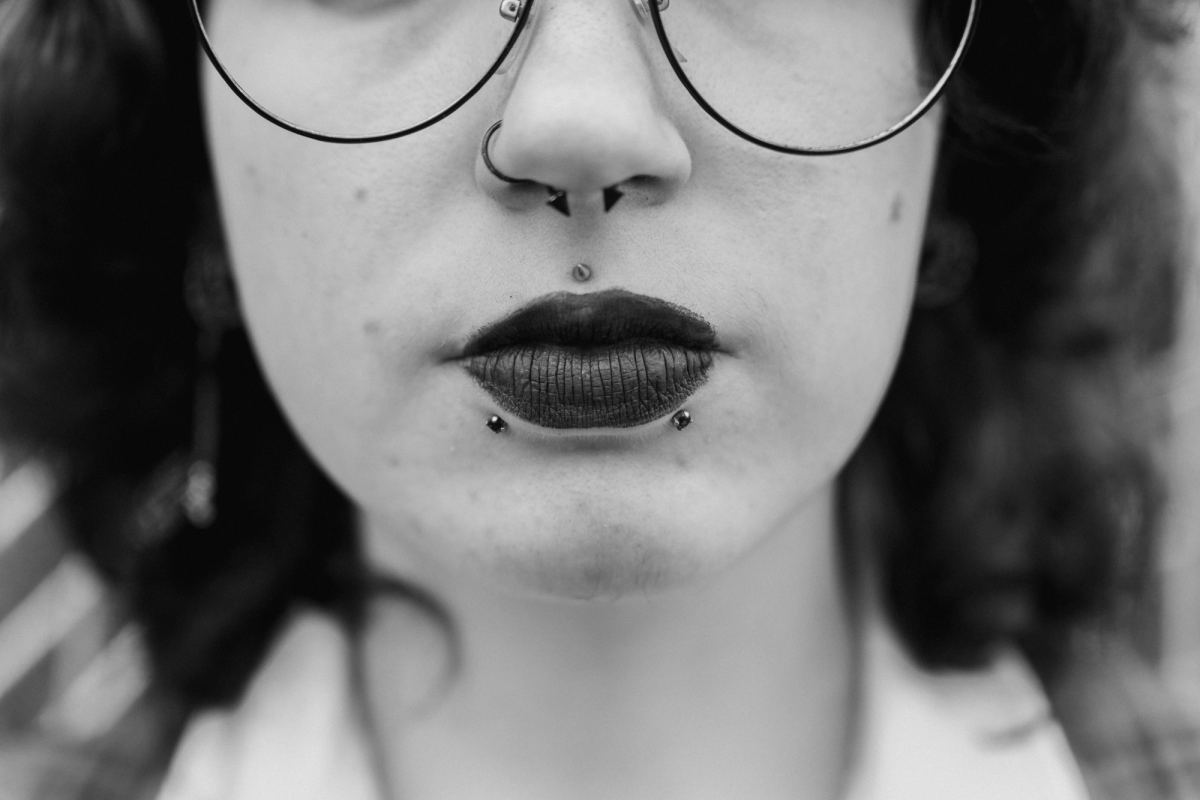
A vertical labret typically has visible ends at the lower lip and its underside. The curve of the jewellery should follow this channel, so a conventional inside-mouth backing is not the same design.
The lip piercing jewellery size guide explains how curved jewellery dimensions differ from straight-post lengths and ring openings.
Choosing ends
Two small smooth ends may be easier to accommodate than spikes or wide ornaments. Check that the top does not interfere with ordinary lip movement.

Why no product picks
Our selected feed entries do not establish an appropriate curved barbell for this placement. Ask a qualified piercer for an exact curved-barbell specification before ordering.
Why a vertical labret is not a regular labret turned upright
In a conventional lower-lip labret, a straight post commonly leads to a backing on the inside of the mouth. In a vertical labret, the intended route passes through the lower lip with two visible external ends. The jewellery typically used for these two placements is therefore different, despite the shared name.
A curved barbell is often selected for a vertical labret because the shape can follow the intended geometry. Its length and curvature must be appropriate for the actual channel. A straight flat-back stud taken from a conventional lip category is not an alternative simply because its headline contains the word labret.
The two visible ends are part of the aesthetic. A small ornament above the lip and a second end below it can create a deliberate vertical line. Different combinations of polished balls or decorative ends may change how prominent that line appears. But visual balance comes after assessment of the wearable shape, tissue depth and clearance.
If you are planning the piercing, ask the studio to explain the proposed construction rather than purchasing jewellery in anticipation. A piercer may advise that a particular placement or jewellery shape is not suited to your anatomy. That is more useful information than a retailer's generic recommendation for vertical labrets.
What to look for in a suitable curved barbell listing
A useful listing should identify the material, gauge, wearable length, curvature, end dimensions and attachment system. Some sellers use a straight-line measurement between ends for curved pieces; others may describe their products differently. Ask what the measurement represents before comparing it with your specification.
The curvature is not fully described by the gauge and length. Two pieces with the same nominal length can have different shapes. For a vertical labret, the way the curve relates to the tissue matters. Do not try to reshape an assembled piece in the piercing to compensate for unsuitable geometry.
End dimensions also need consideration. Two decorative ends may have different profiles and widths. The upper ornament may be more visible during conversation, while the lower end sits against the external surface below the lip. An enlarged top or bottom end can change the overall clearance, even when the barbell length is unchanged.
A product image should be used to understand the general design, not measure its dimensions. Ask your piercer to establish the required curve and length and confirm whether a retailer's particular piece is suitable. If the specification is incomplete, a professionally supplied piece is a reasonable alternative.
Comparing two-end styling options
A matching pair of smooth round ends creates a relatively restrained and balanced appearance. A gem at one end and a plain ball at the other can introduce contrast without making both ornaments elaborate. Coordinated colours can complement nearby facial jewellery while still allowing each piercing to have its own geometry.
A broad top, spike or sharply projecting ornament may be visually appealing but changes how the piece occupies the lip area. Consider ordinary mouth movement, clothing and other objects that can contact the face. Do not assume a dramatic look photographed for a few seconds is necessarily practical for everyday wear.
If you already own a suitable curved barbell, ask whether compatible replacement ends are available. Both ends need their connection type and dimensions confirmed. An end designed for a different post may not be compatible even when its advertised gauge sounds similar.
Avoid treating a complete ring or circular barbell as interchangeable with the curved barbell selected for your channel. The name of a shape describes its general construction, not a promise that it can follow every lip piercing.
Why this guide does not offer a generic product recommendation
The selected Oufer feed entries reviewed for this cluster include conventional labret studs and lip rings. We have not established an exact curved-barbell product and variant that can be responsibly presented as a verified vertical labret option. Rather than insert an unrelated product to fill a shopping section, this guide focuses on the specification you need.
A good next step is to obtain a written description of the current professionally fitted jewellery. Include the manufacturer or compatible end system, the gauge, wearable length and any curvature information the studio considers relevant. If you are sourcing a replacement online, ask the retailer to confirm each of those details.
For a fresh or healing piercing, leave selection and changes to your piercer. Cosmetic replacement is distinct from a professionally assessed change needed to address swelling or fit. If an end appears to be pressing into tissue or the piece feels unstable, get the issue assessed rather than forcing a different length.
A vertical labret may avoid the conventional inside-mouth backing of a standard labret, but it still involves pierced tissue and potential complications. Seek appropriate care for worrying symptoms. Jewellery marketed for a different type of lip piercing is not a shortcut around these considerations.
Frequently asked questions
Can I order jewellery using only the gauge?
No. Verify shape, length or inner diameter, end design and closure with your piercer.
Is this suitable for a new piercing?
Retail examples are for consideration only after healing and a professional fit check. Initial jewellery is selected and fitted by your piercer.
What if jewellery touches my teeth or gums?
Arrange dental and piercing assessments. Even well-fitted oral jewellery carries risk; the American Dental Association advises against cosmetic oral and perioral piercing.