
What nose jewellery is suitable for sensitive skin?
Choose a verified material and correct fit; persistent irritation needs assessment rather than another speculative purchase.
Affiliate disclosure: We may earn a commission through these links. Selections are based on Oufer catalogue specifications, not hands-on tests. Prices in USD from the supplied Awin feed; check current price, availability and shipping. These examples are for healed piercings only; confirm fit and material documentation.
Options worth comparing

C Shaped Titanium Nose Hoop - 8mm
Open hoop; merchant specifies ASTM F136 titanium.
$10.39 USD — feed price, subject to change.
Product link currently unavailable
18G Hinged Segment Titanium Nose Hoop - Silver / 6mm
Plain hinged hoop; merchant specifies ASTM F136 titanium. Check the compact diameter.
$8.79 USD — feed price, subject to change.
Check price at Oufer
Titanium CZ Nose Screw Stud - Clear
Curved screw with clear CZ; merchant specifies ASTM F136 titanium.
$10.39 USD — feed price, subject to change.
Check price at Oufer| Product | Feed price (USD) |
|---|---|
| C Shaped Titanium Nose Hoop - 8mm | $10.39 |
| 18G Hinged Segment Titanium Nose Hoop - Silver / 6mm | $8.79 |
| Titanium CZ Nose Screw Stud - Clear | $10.39 |
Sensitivity versus pressure
Redness can result from friction, pressure, moisture, infection or allergy. A material change alone cannot identify the cause. Avoid interpreting every bump as nickel sensitivity.
When a professional has identified the appropriate material and fitting, our nose stud guide explains the constructions you may encounter in the shop.
Retailer questions
Ask for the exact alloy, evidence of quality and a description of coatings. A hypoallergenic label is not proof. Some selected listings specify ASTM F136 titanium.
When to get help
Seek medical advice for increasing pain, spreading redness, fever or suspected infection. A piercer can evaluate mechanical fit. Discuss jewellery removal with a clinician if infection is suspected.
Separating comfort from material claims
Sensitivity is a useful concern to raise with a piercer or healthcare professional, but it does not identify a cause by itself. A ring may press against tissue because its diameter is too small, a stud may catch because its post projects, or a rough surface may contribute to friction. A reaction to an alloy or coating is another possibility. These explanations can overlap. A photograph of the piercing cannot reliably distinguish them. Keep track of when the issue started and whether the fit or jewellery changed. Avoid making repeated purchases in an attempt to diagnose a reaction.
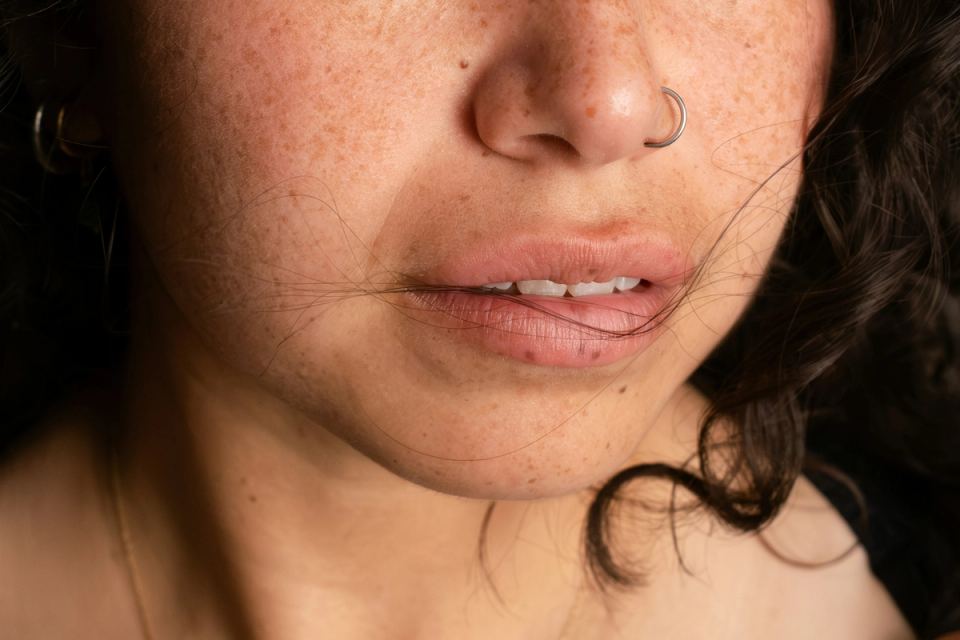
For shopping purposes, ask a seller to identify the exact wearable material and surface treatment. Look for an answer that distinguishes the post, top, stone setting and closure rather than an unsupported hypoallergenic claim. For example, a titanium-labelled post may have a separate top made of a different alloy. A coating may obscure the underlying metal. A simple, correctly sized design with clear material information is a sensible shortlist criterion, but no online product can be guaranteed suitable for your skin. Persistent or worsening symptoms need appropriate professional assessment.

For a related explanation, see Nose Piercing Size Guide: Gauge, Length and Diameter.
Practical comparison checklist
A practical buying sequence
Make a note of location, healing status and existing dimensions before opening a catalogue. Filter incompatible variants first. Then compare materials, closure and appearance. Ask the retailer to confirm unclear measurements, and check the returns policy for body jewellery before ordering. A piece that cannot be returned after opening is a reason to double-check fit, not a reason to try an unsuitable item.
Reading product photographs
Front photographs show decorative appearance but often hide the wearable section. Look for a side view, close-up of closure and size diagram. Do not infer thickness or dimensions from an unscaled image. Likewise, a gold-coloured photograph does not prove a gold alloy, and a silver-coloured finish does not establish titanium.
What to record before a purchase
Record the piercing location, current gauge and applicable wearable length or inner diameter. Write the material and fastening mechanism alongside the size, and save the exact variant. This makes later comparisons more useful and helps avoid selecting a product with a similar title but a different specification.
What to do when a product description is vague
A vague claim that jewellery is suitable for sensitive skin does not provide the material evidence needed to make a useful comparison. Ask for the actual alloy or titanium grade, the material of every wearable component and details of any surface coating. If the seller cannot answer, compare an alternative with clearer information. A product labelled nickel-free may still be uncomfortable because its shape or dimensions are unsuitable, and discomfort alone does not prove a material reaction.
Keep a record of your current jewellery and any changes that coincided with symptoms. Share that information with a qualified piercer or clinician as appropriate. Do not attempt a sequence of jewellery changes as a diagnostic experiment. If symptoms are worsening or suggest infection, medical assessment takes priority over shopping. The affiliate products on this page are examples with retailer-reported material specifications, not products guaranteed to prevent or treat a skin reaction.
Frequently asked questions
Does a nickel-free label rule out irritation?
No. Pressure, friction and other causes can contribute to symptoms even when nickel is absent.
Should I change jewellery repeatedly to identify an allergy?
No. Seek appropriate professional assessment rather than experimenting with multiple pieces.
When should I seek medical advice?
Worsening pain, warmth, spreading redness, fever or suspected infection deserve medical assessment.
Sources and editorial notes
- Association of Professional Piercers: initial jewellery
- Association of Professional Piercers: healed piercings
- Association of Professional Piercers: aftercare
- Oufer Awin product feed, merchant 91941, supplied November 2026.
Editorial guidance is not individual medical or piercing advice.