

What makes initial piercing jewellery suitable?
Initial jewellery should be chosen and fitted by a qualified piercer using documented suitable materials and construction.
Material
Professional guidance describes implant-certified titanium and specific suitable gold alloys among possible materials. Avoid vague labels; ask about evidence and finish.
The nose stud guide explains the construction of replacement studs, while the nose size guide explains terminology; neither substitutes for professional initial fitting.
Construction
The wearable surface should be smooth and suitable for sterilisation. Internally threaded or threadless assemblies avoid exposed insertion threads. The piercer must allow room for swelling.
Do not buy by a photograph
Online listings cannot establish whether a piece matches your anatomy or is ready for sterile insertion. We do not recommend retail products as initial jewellery based solely on a feed.
What a professional assesses
Initial jewellery selection begins with the placement and anatomy of the proposed piercing. The professional needs to consider the direction of the channel, room for swelling, smoothness of the wearable surface and whether the entire assembly is appropriate for sterilisation and insertion. A familiar product name or attractive photograph is not enough. Ask the piercer what material specification they use, how they verify it and why they recommend the particular shape and length. Different placements and individual circumstances may require different choices.
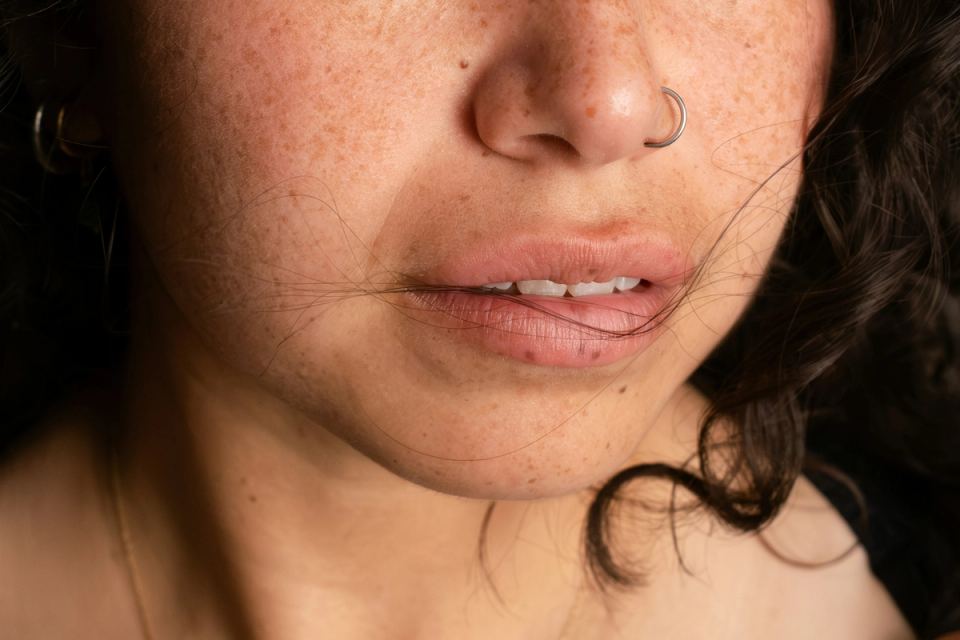
Material claims should be specific and supported. Professional piercing guidance describes certain implant-certified titanium specifications and suitable gold alloys among possible choices. This does not mean every item labelled titanium or gold is appropriate. The construction, surface finish and preparation also matter. Internally threaded or threadless assemblies avoid exposed insertion threads on the wearable section. Do not assume a retail product listed for an established piercing is appropriate for a fresh one. We deliberately exclude affiliate product recommendations from this article because an initial fitting requires individual professional assessment.

For a related explanation, see Nose Piercing Size Guide: Gauge, Length and Diameter.
Questions to take to your piercing appointment
Ask your piercer which material standard is used for the proposed initial jewellery, how the shop verifies it and which components the specification covers. Discuss why the recommended shape and wearable length suit the placement and how the shop allows for initial swelling. Ask how any later size adjustment will be assessed. These questions are more useful than bringing an unverified online product and asking whether it can be inserted.
A professional fitting includes factors that are not established by a retail description: individual anatomy, the direction of the channel and preparation of the jewellery for insertion. A product may be marketed for healed nostrils or septums without being suitable for a new piercing. Do not infer sterilisation or initial suitability from packaging photographs. If you want a specific aesthetic, discuss the appearance with the piercer and ask which suitable options can achieve it safely.
Frequently asked questions
Can I select initial jewellery by metal alone?
No. Construction, smoothness, fit, preparation and individual anatomy matter.
What should I ask about titanium?
Ask your piercer which specification applies and how the shop verifies it.
Can I bring an online product to a piercing appointment?
Discuss it in advance. Do not assume a retail product is acceptable for initial insertion.
Sources and editorial notes
- Association of Professional Piercers: initial jewellery
- Association of Professional Piercers: healed piercings
- Association of Professional Piercers: aftercare
Editorial guidance is not individual medical or piercing advice.