

How thick are 18G and 20G jewellery?
18G is about 1.0 mm thick; 20G is about 0.8 mm. A lower gauge number means a thicker piece.
Affiliate disclosure: We may earn a commission through these links. Selections are based on Oufer catalogue specifications, not hands-on tests. Prices in USD from the supplied Awin feed; check current price, availability and shipping. These examples are for healed piercings only; confirm fit and material documentation.
Options worth comparing

18G Hinged Segment Titanium Nose Hoop - Silver / 6mm
Plain hinged hoop; merchant specifies ASTM F136 titanium. Check the compact diameter.
$8.79 USD — feed price, subject to change.
Check price at Oufer
20G 14K Gold CZ Segment Nose Hoop - 8mm
Decorated hinged hoop; verify gold construction.
$99.99 USD — feed price, subject to change.
Check price at Oufer| Product | Feed price (USD) |
|---|---|
| 18G Hinged Segment Titanium Nose Hoop - Silver / 6mm | $8.79 |
| 20G 14K Gold CZ Segment Nose Hoop - 8mm | $99.99 |
Gauge is not diameter
An 18G ring with 6 mm inner diameter and a 20G ring with 6 mm inner diameter have similar openings but differ in wire thickness.
For the distinction between thickness and fit, see our nose piercing size guide; if shopping for a septum ring, consult the septum jewellery guide separately.
Compatibility
Do not assume your nostril is pierced at one standard gauge. Check current jewellery or ask your piercer. Thicker jewellery may not fit without professional assessment.
Shopping examples
These feed entries illustrate different nominal gauges. They are not recommendations to switch gauge. Check the precise variant before buying.
Reading gauge labels accurately
The gauge label is a nominal thickness designation. In common body-jewellery listings, 18G corresponds to roughly 1.0 mm and 20G to roughly 0.8 mm. This means the 18G piece is the thicker of the two, even though its numerical gauge is smaller. Some listings include both a gauge and a millimetre dimension; read carefully to determine whether the latter is thickness, ring diameter or post length. If the description is ambiguous, ask the retailer rather than interpreting the larger number as the gauge.
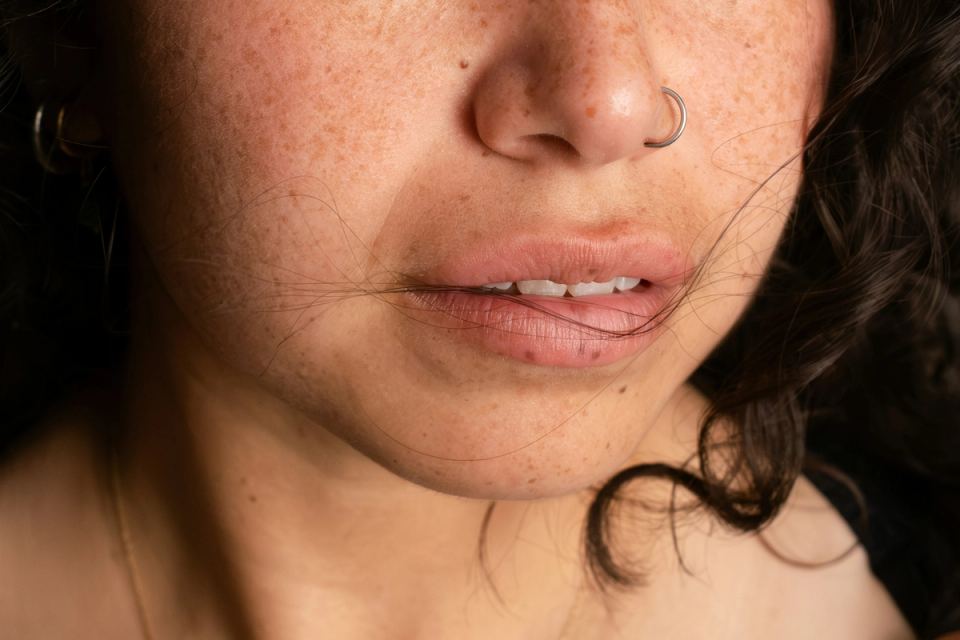
The difference in diameter between 18G and 20G may look small, but a piercing is not a hole that can safely accommodate any nearby size. The channel and the current jewellery have their own dimensions. Never force a thicker item in because the numbers seem close. If you are unsure what was fitted originally, ask your piercer to measure or identify the current piece. Choosing a thinner ring can also alter the fit and how pressure is distributed. A change of gauge is not simply a fashion choice, particularly for a piercing that has not fully healed.

For a related explanation, see Nose Piercing Size Guide: Gauge, Length and Diameter.
Using millimetres to compare listings
Imagine two product descriptions: one says 18G and 8 mm, the other says 20G and 8 mm. If both describe circular hoops with an 8 mm inner opening, the second is nominally thinner, while the openings are the same size. This example does not mean either is suitable for a given piercing. The gauge and opening should be compared independently, and both must match the requirements of the placement.
If a listing instead says 0.8 mm by 6 mm, ask whether the first figure refers to thickness and the second to usable length or inner diameter. The convention varies with the jewellery type. Save the exact dimensions in millimetres when possible rather than relying solely on a gauge label. Do not force a thicker item into the channel or assume a thinner one is harmless for every placement. Ask a piercer about any proposed change of gauge.
Frequently asked questions
Which is thicker, 18G or 20G?
18G is nominally thicker, approximately 1 mm versus 0.8 mm.
Does changing gauge change ring diameter?
Not necessarily. The internal opening and thickness are separate specifications.
Can I stretch a piercing by forcing in 18G jewellery?
No. Ask a piercer about any proposed change of gauge.
Sources and editorial notes
- Association of Professional Piercers: initial jewellery
- Association of Professional Piercers: healed piercings
- Association of Professional Piercers: aftercare
- Oufer Awin product feed, merchant 91941, supplied November 2026.
Editorial guidance is not individual medical or piercing advice.